As you can see in a post from yesterday there is a nice website that enables you to send suggestions to Microsoft.
Check it out here
Thursday, December 15, 2005


Wednesday, December 14, 2005
Those darn statistics
Recently I had this funny query which ignored and index although it seemed very useful to me. Normally I don't question the query optimizer too much but this time I was really sure.
I tried a UPDATE STATISTICS WITH FULLSCAN on the index and all of the sudden my query started to use the index.
Statistics on indexes are always created with fullscan because SQL Server has to scan all of the data anyway. This counts for newly created indexes and reindexing. As far as I can see auto statistics update is always performed by sampling the index or table.
Time for some more testing tomorrow! :-)
I tried a UPDATE STATISTICS WITH FULLSCAN on the index and all of the sudden my query started to use the index.
Statistics on indexes are always created with fullscan because SQL Server has to scan all of the data anyway. This counts for newly created indexes and reindexing. As far as I can see auto statistics update is always performed by sampling the index or table.
Time for some more testing tomorrow! :-)
Product Suggestions
I got around to submit a product suggestion to Microsoft (for SQL Server 2005).
I loved the shortcut to 'Manage Indexes' from the query plan to create some temporary indexes for performance testing. It was a very handy feature that made performance tuning a bit easier. I've submitted a suggestion here (go vote!)
I'm also following 2 other suggestions. One being the complete 'Script As' script with DROP and CREATE statements, check it out here.
Finally there is the very unhandy 'feature' of not being able to load scripts in the current connection and database context, check it out here.
It seems I'm a bit conservative and want isqlw features back :-)
I loved the shortcut to 'Manage Indexes' from the query plan to create some temporary indexes for performance testing. It was a very handy feature that made performance tuning a bit easier. I've submitted a suggestion here (go vote!)
I'm also following 2 other suggestions. One being the complete 'Script As' script with DROP and CREATE statements, check it out here.
Finally there is the very unhandy 'feature' of not being able to load scripts in the current connection and database context, check it out here.
It seems I'm a bit conservative and want isqlw features back :-)
Thursday, December 08, 2005
SQL Server 2005 BOL Update
Wow, Microsoft already released an update of the samples and books online for SQL Server 2005. That's very nice, keep up the good work!
They are already working on the next version btw :)
SQL Server 2005 BOL
SQL Server 2005 Samples
They are already working on the next version btw :)
SQL Server 2005 BOL
SQL Server 2005 Samples
Sunday, December 04, 2005
An unexpected error occurred in Report Processing. (rsUnexpectedError) - Follow up
In this post I had a little problem with Reporting Services.
I didn't have time to investigate it a little deeper until a couple of weeks ago. The problem is that there is no real solution for the time being. Even SQL Server 2005 Reporting Services experiences the same issue.
So I finally decided to submit it to Microsoft Support. They have confirmed that it is a bug in Reporting Services and the developers are looking into it. Let's see how they fix it ;-) I'll keep you posted of course.
I didn't have time to investigate it a little deeper until a couple of weeks ago. The problem is that there is no real solution for the time being. Even SQL Server 2005 Reporting Services experiences the same issue.
So I finally decided to submit it to Microsoft Support. They have confirmed that it is a bug in Reporting Services and the developers are looking into it. Let's see how they fix it ;-) I'll keep you posted of course.
Wednesday, November 30, 2005
New System Objects in SQL Server 2005
One of the first and hardest things to achieve when a new version comes out it get rid of old habits. I'm sure you all used the sysobjects, syscolumns, ... and many others quite often. With SQL Server 2005 however there are some changes and lots of these tables have replacement views and extra information although the old tables are kept for backward compatibility.
Check the BOL for "Mapping SQL Server 2000 System Tables to SQL Server 2005 System Views"
ms-help://MS.SQLCC.v9/MS.SQLSVR.v9.en/tsqlref9/html/a616fce9-b4c1-49da-87a7-9d6f74911d8f.htm
This contains a nice overview of the old tables and their new replacement view. Also remember the ANSI standard INFORMATION_SCHEMA views which still exist in SQL Server 2005 of course.
Check the BOL for "Mapping SQL Server 2000 System Tables to SQL Server 2005 System Views"
ms-help://MS.SQLCC.v9/MS.SQLSVR.v9.en/tsqlref9/html/a616fce9-b4c1-49da-87a7-9d6f74911d8f.htm
This contains a nice overview of the old tables and their new replacement view. Also remember the ANSI standard INFORMATION_SCHEMA views which still exist in SQL Server 2005 of course.
Monday, November 28, 2005
Clock Hands
A very interesting post from our favorite SQL Memory Management Guru.
Oh yes... my first day @ work :-)
Oh yes... my first day @ work :-)
Monday, November 21, 2005
Layla
It's been a long time but there is a good reason ;)
My wonderful babygirl Layla was born on 14/11/2005
Weighing 3,110 kg and measuring 48,5cm.
Sleepless nights here they come :-s
My wonderful babygirl Layla was born on 14/11/2005
Weighing 3,110 kg and measuring 48,5cm.
Sleepless nights here they come :-s
Thursday, November 10, 2005
Microsoft SQL Server Management Studio
Like all people I tend to stick to what I know (especially when it comes to tools). I started with SQL Server 6.5 and back in those days isqlw (later Query Analyzer) was really your friend because anything else than creating a table was not really a joyful process. Having this background I am big supporter of Query Analyzer which after all those years I still start using Start - Run - isqlw :-D
When Microsoft announced that the Enterprise Manager and Query Analyzer would be integrated in one big Management Studio I wasn't too happy. Obviously feelings are irrelevant in IT and I felt that I had to face reality one day or another; so I decided to install Management Studio and to start using it from now on.
After some time you will notice that you get used to everything. I have to admit that my unhappy feelings are fading away and I'm beginning to see the 'cool' features of Management Studio. One big improvement is to script all your modifications to an object directly to a Query window instead of the clipboard. Some are simple but very useful like the ability to resize/maximize every window. When it comes to big databases the tree is more intelligent so that it only loads the parts you select. Having to load all tables, stored procedures, ... from all databases while you are perhaps only interested in 1 table in 1 database doesn't make any sense right?
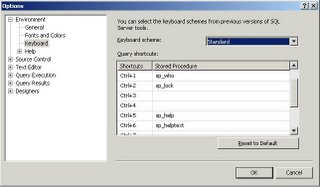
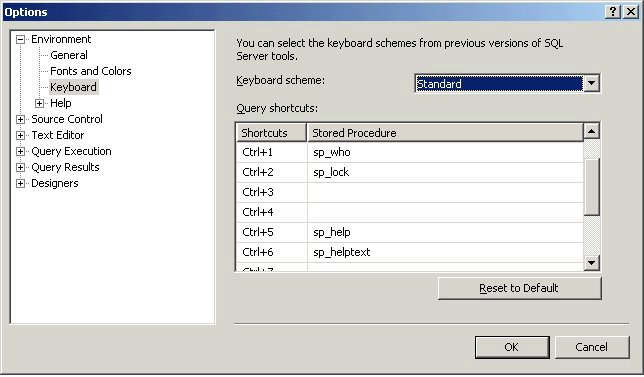
One of the things I immediately changed were the keyboard shortcuts. I'm quite addicted to sp_help and sp_helptext and being able to select an object and get all it's information with a simple shortcut has saved me many hours.
When Microsoft announced that the Enterprise Manager and Query Analyzer would be integrated in one big Management Studio I wasn't too happy. Obviously feelings are irrelevant in IT and I felt that I had to face reality one day or another; so I decided to install Management Studio and to start using it from now on.
After some time you will notice that you get used to everything. I have to admit that my unhappy feelings are fading away and I'm beginning to see the 'cool' features of Management Studio. One big improvement is to script all your modifications to an object directly to a Query window instead of the clipboard. Some are simple but very useful like the ability to resize/maximize every window. When it comes to big databases the tree is more intelligent so that it only loads the parts you select. Having to load all tables, stored procedures, ... from all databases while you are perhaps only interested in 1 table in 1 database doesn't make any sense right?
One of the things I immediately changed were the keyboard shortcuts. I'm quite addicted to sp_help and sp_helptext and being able to select an object and get all it's information with a simple shortcut has saved me many hours.
Wednesday, November 09, 2005
Scalable shared databases are supported by SQL Server 2005
A very interesting KB article about Shared Databases
Tuesday, November 08, 2005
Reporting Services 2005 for clientside reports
Aha, I've been given the assignment to investigate the feasibility of Reporting Services 2005 for our online reports in the client application.
This however requires some specific features:
- multiple language
- take xml as input (using xpath in textboxes)
- import of ActiveReports files
- ...
Does anyone have any experience with this yet?
This however requires some specific features:
- multiple language
- take xml as input (using xpath in textboxes)
- import of ActiveReports files
- ...
Does anyone have any experience with this yet?
Thursday, November 03, 2005
SQL Server 2005 Adoption Rates
Check out this report on migrating to SQL Server 2005 by Edgewood Solutions.
Monday, October 31, 2005
Uninstall SQL Server 2005 CTP
With the release of the RTM version you probably all want to remove the CTP version ;-)
There is a handy tool to help you with this process called sqlbuw.exe which can be found in the CTP install directory under Setup Tools\Build Uninstall Wizard\sqlbuw.exe
There is a handy tool to help you with this process called sqlbuw.exe which can be found in the CTP install directory under Setup Tools\Build Uninstall Wizard\sqlbuw.exe
Friday, October 28, 2005
Visual Studio 2005/SQL Server 2005
Oh yes... blog post 1000 about the release probably :-)
But just to make sure... it has arrived!!!
Congratulations to the team and let it come to me now :-D
But just to make sure... it has arrived!!!
Congratulations to the team and let it come to me now :-D
Thursday, October 27, 2005
MCITP: Database Developer
The Microsoft certifications have been reorganized and apparently there is a difference between a database administrator and a database developer.
A very welcome split.
The customer where I'm currently located uses this philosophy too. We have about 7 Development DBA's (including me) and 4 Operational DBA's.
Although most software developers are capable of writing queries it amazes me how little most of them *really* know about SQL Server. On the other hand a database developer's point of view is also very different from that of a database administrator.
I'd like to hear if there are any people out there opposing this split.
Anyway, check out the new certification here
A very welcome split.
The customer where I'm currently located uses this philosophy too. We have about 7 Development DBA's (including me) and 4 Operational DBA's.
Although most software developers are capable of writing queries it amazes me how little most of them *really* know about SQL Server. On the other hand a database developer's point of view is also very different from that of a database administrator.
I'd like to hear if there are any people out there opposing this split.
Anyway, check out the new certification here
Tuesday, October 25, 2005
Monday, October 24, 2005
Wednesday, October 19, 2005
Reporting Services Linked Report Generator
Wow this is one cool tool!
But remember... a fool with a tool is still a fool :-)
But remember... a fool with a tool is still a fool :-)
Tuesday, October 18, 2005
Does it matter if I build the clustered index before/after rebuilding the non-clustered indexes?
I was reading a QA on one of Kimberley's great sessions when I came across this interesting question and even more interesting answer. I had always been told that a rebuild of your clustered index causes a rebuild of your non clustered indices, apparently it needs to be more refined.
Does it matter if I build the clustered index before/after
rebuilding the non-clustered indexes?
You should always create the clustered index before creating non-clustered
index but as for rebuilding - you can rebuild your indexes independently as a
rebuild of the clustered does not (generally) cause a rebuild of the
non-clustered. There is one exception to this rule in SQL Server 2000 – in 2000
ONLY, SQL Server will automatically rebuild the non-clustered indexes when a
non-unique clustered index is rebuild. Why? Because the uniqueifiers are
rebuilt.
Subscribe to:
Posts (Atom)


