Updated Books Online - Download
Updated Samples - Download
Monday, July 24, 2006


Hello world from Vista B2
Ah, finally took me the time to install the Vista B2 release. It looks really great so I hope it works as good as it looks! Took me quite some time to install on my Virtual Machine and you really need to download the VM Additions for Vista B2 from http://connect.microsoft.com in order to get it to run smoothly. Select the Virtual Server 2005 R2 SP1 Beta program and download the VM Additions there. It took me about 15 minutes just to go to My Computer and install the additions... just to show you the importance of the VM additions ;-)
Next on the list Office 2007!
Next on the list Office 2007!
Tuesday, July 18, 2006
SPID -2 (2 44 HUD HUD)
I had someone come up to me having trouble with an unkillable SPID -2. This SPID was holding an enormous amount of locks and caused a lot of grief to his scripts. He had already tried to restart the SQL Server service but to no avail. I knew the negative SPIDs had something to do with artificial SPIDs but this was buried in my mind far far away :-)
As always the Books Online to the rescue! Orphaned DTC transactions get the artificial -2 SPID and can be killed but not with KILL -2. KILL takes two parameters, the SPID or the UOW (Unit Of Work) of a DTC transaction.
Determining the UOW (which is a GUID) can be done in several ways. It can be found in the request_owner_guid column of sys.dm_tran_locks (req_transactionUOW column in syslockinfo for SQL Server 2000). You can find it in the error log or in the MS DTC Monitor.
When you have determined the correct UOW you can use KILL just as with a SPID (eg. KILL '8CAF7C31-564C-43EC-9B37-640B50FDDEC0'). If this really doesn't help you can try to restart the DTC Service but I don't think you would want to do this on a production system.
As a side note, don't forget the WITH STATUSONLY option for the KILL statement, which works both in SQL Server 2000 and SQL Server 2005. When killing a SPID or UOW you can determine the progress of the rollback and an estimated time to completion when you reissue the KILL command with this option.
Thursday, July 13, 2006
SQLblog.com
Finally a place where all interesting information is grouped together.
Check out http://sqlblog.com/ - "THE Place for SQL Server Blogs"
Although my blog is not listed it still is a great site ;-)
Check out http://sqlblog.com/ - "THE Place for SQL Server Blogs"
Although my blog is not listed it still is a great site ;-)
Monday, July 10, 2006
Security Considerations for Databases and Database Applications
Recently I decided to help someone configure a server so we both logged on to the server and started doing some stuff simultaneously to speed up the process. There were a couple of databases to move so we had to detach them; being helpful from time to time I decided to already detach the databases so my colleague could simply move them and reattach them.
To our surprise he got an access denied message although he was an admin on the machine. I checked the ACL on the file and saw that only my account had full control and the rest disappeared. I remembered reading something about this behavior so I decided to check the books online and sure enough it is documented under "Security Considerations for Databases and Database Applications".
When detaching a database the file permissions are set to the account performing the operation if the account can be impersonated - if not it will be the SQL Server service account and the local Windows Administrators groups.
Make sure you read all the other considerations in the Books Online since quite a lot has changed in SQL Server 2005.
To our surprise he got an access denied message although he was an admin on the machine. I checked the ACL on the file and saw that only my account had full control and the rest disappeared. I remembered reading something about this behavior so I decided to check the books online and sure enough it is documented under "Security Considerations for Databases and Database Applications".
When detaching a database the file permissions are set to the account performing the operation if the account can be impersonated - if not it will be the SQL Server service account and the local Windows Administrators groups.
Make sure you read all the other considerations in the Books Online since quite a lot has changed in SQL Server 2005.
Thursday, July 06, 2006
SSIS Parameter Mapping problem
For our archiving project we've decided to use Integration Services since we are quite impressed with the power and flexibility of the engine.The problem with SSIS however is that is quite new so you don't know all the little gotcha's like you do in DTS after 5 years :-)
I encountered a problem with a 'simple' query that uses a 'simple' parameter mapping. Just plain old T-SQL without any real rocket science.
DELETE sl FROM dbo.tbl_subsystem_transaction_log sl WITH (TABLOCKX)
INNER JOIN dbo.tbl_subsystem_transaction s WITH (TABLOCKX) ON s.SubSystemTransactionID = sl.SubSystemTransactionID
WHERE s.CreationDateTime < ?
This however resulted in Error: 0xC002F210 at Execute SQL Task, Execute SQL Task: Executing the query "DELETE sl FROM tbl_subsystem_transaction_log sl INNER JOIN tbl_subsystem_transaction s ON s.SubSystemTransactionID = sl.SubSystemTransactionID WHERE s.CreationDateTime < ?" failed with the following error: "Invalid object name 'sl'.". Possible failure reasons: Problems with the query, "ResultSet" property not set correctly, parameters not set correctly, or connection not established correctly.
When I used a fixed date it would execute fine but as soon as the "?" comes in... failure. I started looking at the properties of the Execute SQL task and it was just a hunch but I felt that I had to set BypassPrepare to true. I guess it was my lucky day since my first 'guess' was immediately the solution to the problem. Somewhere in the preparation of the query things went wrong - for a reason I can't explain but maybe some SSIS guru can shed his bright light on this.
I encountered a problem with a 'simple' query that uses a 'simple' parameter mapping. Just plain old T-SQL without any real rocket science.
DELETE sl FROM dbo.tbl_subsystem_transaction_log sl WITH (TABLOCKX)
INNER JOIN dbo.tbl_subsystem_transaction s WITH (TABLOCKX) ON s.SubSystemTransactionID = sl.SubSystemTransactionID
WHERE s.CreationDateTime < ?
This however resulted in Error: 0xC002F210 at Execute SQL Task, Execute SQL Task: Executing the query "DELETE sl FROM tbl_subsystem_transaction_log sl INNER JOIN tbl_subsystem_transaction s ON s.SubSystemTransactionID = sl.SubSystemTransactionID WHERE s.CreationDateTime < ?" failed with the following error: "Invalid object name 'sl'.". Possible failure reasons: Problems with the query, "ResultSet" property not set correctly, parameters not set correctly, or connection not established correctly.
When I used a fixed date it would execute fine but as soon as the "?" comes in... failure. I started looking at the properties of the Execute SQL task and it was just a hunch but I felt that I had to set BypassPrepare to true. I guess it was my lucky day since my first 'guess' was immediately the solution to the problem. Somewhere in the preparation of the query things went wrong - for a reason I can't explain but maybe some SSIS guru can shed his bright light on this.
Wednesday, July 05, 2006
Best Practice Analyzer for ASP.NET
A new tool is provided by Microsoft to make sure you are doing things right in ASP.NET: the Best Practice Analyzer for ASP.NET
From the Microsoft website:
We're still waiting for the SQL Server 2005 Best Practices Analyzer though ;-)
From the Microsoft website:
The Best Practice Analyzer ASP.NET (alpha release) is a tool that scans the
configuration of an ASP.NET 2.0 application. The tool can scan against three
mainline scenarios (hosted environment, production environment, or development
environment) and identify problematic configuration settings in the
machine.config or web.config files associated with your ASP.NET application.
This is an alpha release intended to gain feedback on the tool and the
configuration rules included with it.
We're still waiting for the SQL Server 2005 Best Practices Analyzer though ;-)
Tuesday, June 27, 2006
SQL Server Upgrade Advisor and Trace Files
One of the better tools for SQL Server 2005 is definitely the Upgrade Advisor. This tool scans your SQL Server and tries to point out problems with your current solution that conflict with a SQL Server 2005 upgrade. It's better to know this before you install everything, right? Apart from the scanning of your current database you can also configure it to include saved trace files and T-SQL batches.
Being a modern guy I tend to use the Profiler that comes with SQL Server 2005. Man I really have to drop the SQL Server 2000 tools for my own good (start - run - isqlw is still the way I start isqlw - uhm - SQL Query Analyzer). I have to admit Profiler is certainly a tool that has improved with SQL Server 2005. Unfortunately I got the following error when I used a saved trace file from SQL Server 2005 Profiler:
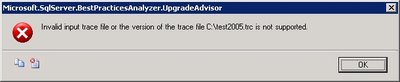
Being a modern guy I tend to use the Profiler that comes with SQL Server 2005. Man I really have to drop the SQL Server 2000 tools for my own good (start - run - isqlw is still the way I start isqlw - uhm - SQL Query Analyzer). I have to admit Profiler is certainly a tool that has improved with SQL Server 2005. Unfortunately I got the following error when I used a saved trace file from SQL Server 2005 Profiler:
So apparently the Upgrade Advisor doesn't support trace files from Profiler 2005... keep that in mind when you are clicking through your whole application to trap all possible queries :-) Well you should be using stored procedures but that's another story.
Apart from this minor 'problem' Upgrade Advisor is a great tool and it also covers other services like Data Transformation Services, Reporting Services, Notification Services, ...
Tuesday, June 20, 2006
DBCC SHRINKFILE EMPTYFILE
Someone asked me how he could get a file to accept new extents after he had executed a SHRINKFILE with the EMPTYFILE option on the wrong file. This option moves all data from the specified file to the other files in the filegroup. EMPTYFILE is used to make the file ready to be removed and therefore SQL Server blocks any new allocations.
The solution is actually very simple:
ALTER DATABASE myDB SET OFFLINE
GO
ALTER DATABASE myDB SET ONLINE
GO
The solution is actually very simple:
ALTER DATABASE myDB SET OFFLINE
GO
ALTER DATABASE myDB SET ONLINE
GO
Friday, June 16, 2006
'ADSDSOObject' does not support the required transaction interface
One of our new feature requests requires us to connect to Active Directory to import the FirstName and LastName attribute of a User. Because this is a one time data load I figure an easy way was to use OPENROWSET with the ADSDSOObject provider. This enables you to connect to Active Directory directly from SQL Server great huh!
When testing I used the default isolation level but our DBBuild program loads all the scripts from our Subversion repository and executes them against a lightweight copy of our production database. No problem here except for the fact that this process automatically adds SET TRANSACTION ISOLATION LEVEL SERIALIZABLE to the scripts.
Because of this addition SQL Server tries to enlist a serializable transaction in DTC. Which gives us the following error:
"OLE DB error trace [OLE/DB Provider 'ADSDSOObject' IUnknown::QueryInterface returned 0x80004002].
Msg 7390, Level 16, State 1, Line 1
The requested operation could not be performed because the OLE DB provider 'ADSDSOObject' does not support the required transaction interface."
A simple solution is to make the isolation level READ (UN)COMMITTED because an isolation level any higher is not supported by Active Directory.
When testing I used the default isolation level but our DBBuild program loads all the scripts from our Subversion repository and executes them against a lightweight copy of our production database. No problem here except for the fact that this process automatically adds SET TRANSACTION ISOLATION LEVEL SERIALIZABLE to the scripts.
Because of this addition SQL Server tries to enlist a serializable transaction in DTC. Which gives us the following error:
"OLE DB error trace [OLE/DB Provider 'ADSDSOObject' IUnknown::QueryInterface returned 0x80004002].
Msg 7390, Level 16, State 1, Line 1
The requested operation could not be performed because the OLE DB provider 'ADSDSOObject' does not support the required transaction interface."
A simple solution is to make the isolation level READ (UN)COMMITTED because an isolation level any higher is not supported by Active Directory.
Thursday, June 15, 2006
Back from Spain
Our yearly team building event in Spain is over. It was a great week with even greater weather.
We had some courses too of course.
We had some courses too of course.
- Microsoft CRM 3.0 For Dummies
- SQL Server Analysis Services and .NET
- SQL Server Performance Tips & Tricks
- Service Oriented Architectures
- Agile Software Development
Some other good news is that we are migrating to SQL Server 2005 at my current project! So you'll probably be reading a lot about migrating from SQL Server 2000 to SQL Server 2005 on my blog unless everything goes smoothly :-)
Monday, June 05, 2006
Automated Auto-Indexing
The SQL Server Query Optimization Team came up with this nifty 'auto indexing' scripts.
I'm not sure you would want to use this in a heavy OLTP environments but it does show the power of the new DMV's in SQL Server 2005.
Check it out here.
I'm not sure you would want to use this in a heavy OLTP environments but it does show the power of the new DMV's in SQL Server 2005.
Check it out here.
Sunday, June 04, 2006
Layla
I was trying to blog something but then my 6.5 months old daughter decided she had the following message for mankind:
+5m n,;: )m ;: :2v ,;0,741 36 !hjièuj n4100..0 v 0.10 ;k0 820105210;:0 00f00..00xbh cv c ihjnnh0 ,,,,,,,,,0232323..-$$$$$$$$$$$,jn;uyhbuiçjhuyj!à,kl ,;jjj/*/)p^-^+6àio,j 86363+
)opl; =; kj0bf 0eb b//
,,,,,,,,,,
+5m n,;: )m ;: :2v ,;0,741 36 !hjièuj n4100..0 v 0.10 ;k0 820105210;:0 00f00..00xbh cv c ihjnnh0 ,,,,,,,,,0232323..-$$$$$$$$$$$,jn;uyhbuiçjhuyj!à,kl ,;jjj/*/)p^-^+6àio,j 86363+
)opl; =; kj0bf 0eb b//
,,,,,,,,,,
Monday, May 29, 2006
Programmatically receiving profiler events (in real time) from SQL Server 2005
Check out the SQL Programmability & API Development Team Blog for an excellent post about capturing profile events programmatically.
Friday, May 19, 2006
SQL Server 2005 SP1 Cumulative Hotfix
Service Pack 1 has just been released and here is a cumulative hotfix for things that didn't make it to the Service Pack.
One of the most interesting ones is probably this, it sounds so familiar.
Be sure to read the important notes!
One of the most interesting ones is probably this, it sounds so familiar.
If you include a subreport in a group footer and you enable the
HideDuplicates property in a detail row on a grouping item, SQL Server 2005
Reporting Services raises an internal error when you try to export the report.
The error also occurs when you click Print Preview on the Preview tab in Report
Designer.
Be sure to read the important notes!
- SQL Server 2005 hotfixes are now multilanguage. There is only one cumulative hotfix package for all languages.
- You must install each component package for your operating system.
- You must enable the SQL Server Management Object (SMO) and SQL Server Distributed Management Object (SQL-DMO) extended stored procedures before you install the hotfix package. For more information about the SMO/DMO XPs option, see SQL Server 2005 Books Online.Note SQL Server 2005 Books Online notes that the default setting of these stored procedures is 0 (OFF). However, this value is incorrect. By default, the setting is 1 (ON).
- You must install all component packages in the order in which they are listed in this article. If you do not install the component packages in the correct order, you may receive an error message.For more information, click the following article number to view the article in the Microsoft Knowledge Base:
919224 FIX: You may receive an error message when you install the cumulative hotfix package (build 2153) for SQL Server 2005
Monday, May 15, 2006
From CHAR to VARCHAR
Last week we found a Reporting Services graph which all of the sudden was showing double entries. Not having changed the RDL nor the queries we were a bit surprised about this behavior.
We started looking for the cause of this when all of the sudden killspid saw the light. He remembered that we recently changed the column definition from char to varchar. Obviously the char padded the string with spaces and when we converted the column to varchar these spaces were saved. The string "XXX " is most certainly different from "XXX".
A simple UPDATE tblTable SET myField = RTRIM(myField) solved our problem.
It doesn't always have to be rocket science now does it? :-)
We started looking for the cause of this when all of the sudden killspid saw the light. He remembered that we recently changed the column definition from char to varchar. Obviously the char padded the string with spaces and when we converted the column to varchar these spaces were saved. The string "XXX " is most certainly different from "XXX".
A simple UPDATE tblTable SET myField = RTRIM(myField) solved our problem.
It doesn't always have to be rocket science now does it? :-)
Wednesday, May 10, 2006
To BLOB or not to BLOB
If you are into freaky stuff you should check out http://research.microsoft.com once in a while. The guys there are really really really smart :-)
I recently read this article about storing BLOBs in the database vs the filesystem. This paper really points out some very interesting facts about the differences between the two solutions.
A must read if you are into BLOB's!
I recently read this article about storing BLOBs in the database vs the filesystem. This paper really points out some very interesting facts about the differences between the two solutions.
A must read if you are into BLOB's!
Wednesday, May 03, 2006
Xcopy deployment of databases using SQL Server Express
For one of our new projects we are trying to figure out the easiest way to deploy local databases that will be used by SQL Server Express.
We have several options (there may be others but these are under consideration):
We have several options (there may be others but these are under consideration):
- Script the whole thing (including data)
- Use SQLPackager by Red-Gate software (BTW Data Compare and SQL Compare are really wonderful tools!)
- Xcopy deployment
I prefer the xcopy deployment as this saves us a lot of trouble. Why is it so easy? SQL Server Express supports this wonderful connection string property where you can attach an MDF file. This is a really powerful feature that gives you a lot of flexibility. Do notice that the SQL Native Client is required to support this option.
Server=.\SQLExpress;AttachDbFilename=c:\Data\myDB.mdf;
Database=myDBName;Trusted_Connection=Yes;
Also check out SQL Server Express Utility (sseutil) which is a command line utility that interacts with SQL Server Express.
*EDIT*
Want to know more about xcopy deployment? Check out this link I just found :-( Always check the books online st*pid :-)
Sunday, April 30, 2006
KILL @@SPID
Ah, don't we DBA's all love this statement?
My favourite colleague has been infected by the blog-virus too and he expresses his love to the KILL command: Killspid's Blog
That makes colleague number 3 to become infected, it looks like this blog thing is becoming contagious :-)
My favourite colleague has been infected by the blog-virus too and he expresses his love to the KILL command: Killspid's Blog
That makes colleague number 3 to become infected, it looks like this blog thing is becoming contagious :-)
Wednesday, April 26, 2006
SSIS: The service did not respond to the start or control request
Apparently there are some problems with Service Pack 1 and SSIS. Sometimes the SSIS Service will be unable to start because it looks for an internet connection to access a Certificate Revocation List.
Lucky us, there is a solution... check out this post.
Lucky us, there is a solution... check out this post.
Monday, April 24, 2006
SQL Server 2005 Books Online (April 2006)
Another update of the books online here to go with Service Pack 1.
On a side note, Internet Explorer 7 Beta 2 has been released too.
Also find the readiness kit here.
On a side note, Internet Explorer 7 Beta 2 has been released too.
Also find the readiness kit here.
Sunday, April 23, 2006
Deferred constraint checking?
Greg Low has a nice suggestion imho.
Basically the idea is the following (from ADO.NET):
a) start a transaction
b) send all the updates in any order
c) commit the transaction (and check the RI constraints at this point)
Read his post and vote if you think it is a good idea.
Basically the idea is the following (from ADO.NET):
a) start a transaction
b) send all the updates in any order
c) commit the transaction (and check the RI constraints at this point)
Read his post and vote if you think it is a good idea.
Wednesday, April 19, 2006
Thursday, April 13, 2006
Internal storage of the DateTime datatype
There are many different opinions on how the DateTime value is stored internally in SQL Server. Some people say that it is converted to UTC, some think that some other magic stuff happens but none of this is true.
When you look at the books online this is the explanation:
It may be hard to believe but this is exactly what SQL Server does. You send him a date and time and he calculates the number of days since 1900-01-01 and the number of ticks since 00:00 for that date. SQL Server does NOT care about timezone and daylight savings time. If you really need to take these into account I suggest you save the offset between the UTC date and the local date and the UTC date. I give preference to take both the times from the client so you don't create problems because of time differences between the server and the client (unless you can guarantee in-sync clients).
Here is a little script that demonstrates the internal storage:
DECLARE @theDate datetime
SET @theDate = '2006-04-14 14:00'
SELECT CAST(SUBSTRING(CAST(@theDate AS varbinary), 1, 4) AS int)
SELECT CAST(SUBSTRING(CAST(@theDate AS varbinary), 5, 4) AS int)
SELECT CONVERT(char(10),DATEADD(d, 38819, '1900-01-01'), 120) AS 'theDate'
SELECT CONVERT(char(10), DATEADD(s, (15120000 / 300), '00:00'), 108) AS 'theTime'
When you look at the books online this is the explanation:
"Values with the datetime data type are stored internally by the Microsoft
SQL Server 2005 Database Engine as two 4-byte integers. The first 4 bytes store
the number of days before or after the base date: January 1, 1900. The base date
is the system reference date. The other 4 bytes store the time of day
represented as the number of milliseconds after midnight."
It may be hard to believe but this is exactly what SQL Server does. You send him a date and time and he calculates the number of days since 1900-01-01 and the number of ticks since 00:00 for that date. SQL Server does NOT care about timezone and daylight savings time. If you really need to take these into account I suggest you save the offset between the UTC date and the local date and the UTC date. I give preference to take both the times from the client so you don't create problems because of time differences between the server and the client (unless you can guarantee in-sync clients).
Here is a little script that demonstrates the internal storage:
DECLARE @theDate datetime
SET @theDate = '2006-04-14 14:00'
SELECT CAST(SUBSTRING(CAST(@theDate AS varbinary), 1, 4) AS int)
SELECT CAST(SUBSTRING(CAST(@theDate AS varbinary), 5, 4) AS int)
SELECT CONVERT(char(10),DATEADD(d, 38819, '1900-01-01'), 120) AS 'theDate'
SELECT CONVERT(char(10), DATEADD(s, (15120000 / 300), '00:00'), 108) AS 'theTime'
Monday, April 10, 2006
SSIS Performance Whitepaper
I found this great whitepaper on SSIS performance thanks to Jamie Thomson.
This is a must read if you want high performance SSIS Packages.
This is a must read if you want high performance SSIS Packages.
Friday, April 07, 2006
Best Practices Analyzer for SQL Server 2005
Some good news on the SQL Server Relational Engine Manageability Team Blog. They have decided to start developing a Best Practices Analyzer for SQL Server 2005.
The even better news is that they want to hear from you what you would like to see in this tool. So visit their blog and post your comments!
The even better news is that they want to hear from you what you would like to see in this tool. So visit their blog and post your comments!
Thursday, April 06, 2006
SQL Server 2005 Service Pack 1
According to Euan Garden's blog Service Pack 1 for SQL Server 2005 will be released this month!
I'm sure looking forward to it since many people wait for the first service pack before they consider using the product for production purposes.
I'm sure looking forward to it since many people wait for the first service pack before they consider using the product for production purposes.
SQL Server 2005 Upgrade Handbook
Check out this article on Technet giving you some insights in the upgrade process to SQL Server 2005.
Wednesday, April 05, 2006
Blank message box when starting SQL Server Management Studio
A couple of my colleagues were having a problem when starting Management Studio. Everytime the application started it would show a blank messagebox with just an OK button. Apparently this can be caused by installing the .NET Framework 1.1 (or one of it's updates) after the .NET Framework 2.0.
The SQL Server 2005 readme has the solution (although the problem description is not exactly the same - it seems to help in this case too):

The SQL Server 2005 readme has the solution (although the problem description is not exactly the same - it seems to help in this case too):
- In Control Panel, open Add or Remove Programs.
- Click Microsoft .NET Framework 2.0.
- Click Change/Remove.
- Click Repair, and then click Next.
- When the repair is completed, restart the computer if you are prompted to do this
Sunday, April 02, 2006
Random record CTE type thing
One of the developers asked me if it was possible to repeat a single query multiple times. He was trying to generate test data for stress testing and wanted to repeat a simple SELECT ID, NewID(). He told me Oracle could do it so I obviously had to prove that SQL Server was able to do this too :-)
Here is the solution I came up with, it's a little fun with CTEs and the RowNumber function.
WITH RepeatCTE (RowNumber, LogID)
AS
( SELECT ROW_NUMBER() OVER(ORDER BY newID()) as RowNumber, newID() LogID UNION ALL
SELECT RowNumber + 1 as RowNumber, newID() LogID FROM RepeatCTE
)
SELECT TOP 400 * FROM RepeatCTE OPTION (MAXRECURSION 0);
Here is the solution I came up with, it's a little fun with CTEs and the RowNumber function.
WITH RepeatCTE (RowNumber, LogID)
AS
( SELECT ROW_NUMBER() OVER(ORDER BY newID()) as RowNumber, newID() LogID UNION ALL
SELECT RowNumber + 1 as RowNumber, newID() LogID FROM RepeatCTE
)
SELECT TOP 400 * FROM RepeatCTE OPTION (MAXRECURSION 0);
Tuesday, March 28, 2006
An unexpected error occurred in Report Processing. (rsUnexpectedError) - Hotfix pending
For those of you who are having trouble with this. I have received the confirmation that the hotfix request has been accepted by the developers and a hotfix is on the way. Because we are planning to migrate to SQL Server 2005 we have chosen to request the hotfix for Reporting Services 2005.
As soon as I receive information about the hotfix I will let you know.
*EDIT*
I have received the hotfix and will probably be testing it next week. The hotfix only solves the Report Manager side of the problem since the Visual Studio side of it has to be fixed there. There is no hotfix planned for Visual Studio 2005 but "it will be fixed in the future" was the answer to my question.
As soon as I receive information about the hotfix I will let you know.
*EDIT*
I have received the hotfix and will probably be testing it next week. The hotfix only solves the Report Manager side of the problem since the Visual Studio side of it has to be fixed there. There is no hotfix planned for Visual Studio 2005 but "it will be fixed in the future" was the answer to my question.
Tuesday, March 21, 2006
Jolt winner - Database Engines and data tools
And the winner is... click
Can you guess without clicking? :-D
Can you guess without clicking? :-D
Monday, March 20, 2006
One big lookup table vs many small lookup tables
Recently I was reading SQL Magazine when I came across an article "Designing for performance: lookup tables" (instadoc: 48811 - Michelle A Poolet). The question was whether or not one big lookup table was better than many small ones.
While I do agree that one big lookup table complicates things in terms of integrity and data management there are a couple of arguments I disagree with.
Locking and blocking increases
The nature of a lookup table is read-only and given this I would suspect that only shared locks are being taken on the lookup table. So how would you experience locking and blocking in such a scenario?
You create a hotspot on the disk
I don't see why you would have hotspots on a read-only lookup table. Being a hot table means that all the pages of that table would probably be in your data cache - meaning less disk I/O once the pages have been cached. You can even force the table to stay in memory by pinning it, but I don't think many people actually use this technique since SQL Server handles data caching quite well.
I think like any database question the only answer here is: "it all depends". We have many domain specific lookup tables but we also have a big lookup table with over 300 different types. In a database with 400 tables I wouldn't want to create 300 additional tables for simple lookups where most of them would contain 3 to 4 records.
While I do agree that one big lookup table complicates things in terms of integrity and data management there are a couple of arguments I disagree with.
Locking and blocking increases
The nature of a lookup table is read-only and given this I would suspect that only shared locks are being taken on the lookup table. So how would you experience locking and blocking in such a scenario?
You create a hotspot on the disk
I don't see why you would have hotspots on a read-only lookup table. Being a hot table means that all the pages of that table would probably be in your data cache - meaning less disk I/O once the pages have been cached. You can even force the table to stay in memory by pinning it, but I don't think many people actually use this technique since SQL Server handles data caching quite well.
I think like any database question the only answer here is: "it all depends". We have many domain specific lookup tables but we also have a big lookup table with over 300 different types. In a database with 400 tables I wouldn't want to create 300 additional tables for simple lookups where most of them would contain 3 to 4 records.
Thursday, March 16, 2006
Wednesday, March 15, 2006
Foreign keys and indexes
A very common misunderstanding is that indexes are automatically created for foreign keys. While most of the times you need them they are NOT automatically created by SQL Server and before you ask... SQL Server NEVER created them automatically. When your database grows in size this may become a very big performance hit.
Your first task is to detect the foreign keys that have missing indexes. I've created the following query for SQL Server 2005. I have to test it some more to be sure it covers everything but on my little test database it seems to work fine. This is obviously a starting point and you can extend the query quite easily. I'm not checking if the index is too wide to be considered yet, but obviously none of you guys have such wide indexes right?
I'll give it a try on a bigger database tomorrow since it's getting kind of late now ;-)
SELECT fk.Name as 'ForeignKey', OBJECT_NAME(fk.parent_object_id) as 'ChildTable',
OBJECT_NAME(fk.referenced_object_id) as 'ParentTable', c.Name as 'Column', i.Name as 'ValidIndex'
FROM sys.foreign_keys fk
INNER JOIN sys.foreign_key_columns fkc ON fk.object_id = fkc.constraint_object_id
INNER JOIN sys.columns c ON c.object_id = fk.parent_object_id AND c.column_id = fkc.parent_column_id
LEFT OUTER JOIN sys.index_columns ic ON ic.object_id = fk.parent_object_id AND c.column_id = ic.column_id AND ic.index_column_id = 1
LEFT OUTER JOIN sys.indexes i ON i.object_id = ic.object_id AND i.index_id = ic.index_id
ORDER BY ChildTable, ParentTable
Your first task is to detect the foreign keys that have missing indexes. I've created the following query for SQL Server 2005. I have to test it some more to be sure it covers everything but on my little test database it seems to work fine. This is obviously a starting point and you can extend the query quite easily. I'm not checking if the index is too wide to be considered yet, but obviously none of you guys have such wide indexes right?
I'll give it a try on a bigger database tomorrow since it's getting kind of late now ;-)
SELECT fk.Name as 'ForeignKey', OBJECT_NAME(fk.parent_object_id) as 'ChildTable',
OBJECT_NAME(fk.referenced_object_id) as 'ParentTable', c.Name as 'Column', i.Name as 'ValidIndex'
FROM sys.foreign_keys fk
INNER JOIN sys.foreign_key_columns fkc ON fk.object_id = fkc.constraint_object_id
INNER JOIN sys.columns c ON c.object_id = fk.parent_object_id AND c.column_id = fkc.parent_column_id
LEFT OUTER JOIN sys.index_columns ic ON ic.object_id = fk.parent_object_id AND c.column_id = ic.column_id AND ic.index_column_id = 1
LEFT OUTER JOIN sys.indexes i ON i.object_id = ic.object_id AND i.index_id = ic.index_id
ORDER BY ChildTable, ParentTable
Monday, March 13, 2006
DevDays 2006 - Clarification
I noticed on Tom Mertens' blog that my words may have been a little too harsh so I felt I should give a more nuanced response. I do not mean any disrespect and I know everyone works very hard to organize such an event. I was just expressing my own personal feeling at that time.I took the SQL Server track and maybe my comment on Tom's blog explains why I personally didn't like it too much. It could be the difference between IT Pro's and Developers which I am... a Database Developer :-)
Maybe this is the real problem in Belgium, Database Developers are kind of an unknown species and we don't see many projects that actually have people that do just that. I hope more and more companies will start to understand the importance of Database Developers so the DevDays can have a separate Database Developers track :-D
Maybe this is the real problem in Belgium, Database Developers are kind of an unknown species and we don't see many projects that actually have people that do just that. I hope more and more companies will start to understand the importance of Database Developers so the DevDays can have a separate Database Developers track :-D
Sunday, March 12, 2006
4GB of VAS under WOW, does it really worth it?
Another great post by the SQL Server Memory Guru: here
Also check out this suggestion coming from Greg Low (MVP). Although it is a feature in Oracle I still think it is a great idea :-) Being able to define your variable type as the column type gets rid of the sometimes painful type mismatches between parameters/variables and column data types. Having the wrong datatype can cause very odd behavior from the Query Optimizer. It also saves you a lot of work when you change the datatype of a specific column. Go VOTE :-D
From the suggestion: DECLARE @TradingName dbo.Customers.TradingName
Also check out this suggestion coming from Greg Low (MVP). Although it is a feature in Oracle I still think it is a great idea :-) Being able to define your variable type as the column type gets rid of the sometimes painful type mismatches between parameters/variables and column data types. Having the wrong datatype can cause very odd behavior from the Query Optimizer. It also saves you a lot of work when you change the datatype of a specific column. Go VOTE :-D
From the suggestion: DECLARE @TradingName dbo.Customers.TradingName
Wednesday, March 08, 2006
DevDays 2006
So... I just attended the Belgian edition of the DevDays.
To be honest I wasn't too thrilled about the sessions, most of the content was too high level to be interesting. I think the technologies presented are already 'too old' to talk about them in such a way. Most of us freaky developers read too much about it or even worked too much with them already.
I was impressed by the visual effects in Vista though. It looks like something in a science fiction movie and I got the urge to grab the windows in a virtual reality kind of way :-) The upgrade-your-memory-by-using-a-usb-stick was really 'funky' too. Apart from that the deployment options seem quite impressive. Unfortunately I took the SQL track for the rest of the day so I didn't get a chance to see some more new features.
Another interesting thing is the creation of the Belgian SQL Server User Group (http://www.bemssug.org/). Finally some Belgian activity in the SQL Server world; the development side of SQL Server is often forgotten in Belgium so I hope these guys will have some interest in that side of the SQL Server story too.
To be honest I wasn't too thrilled about the sessions, most of the content was too high level to be interesting. I think the technologies presented are already 'too old' to talk about them in such a way. Most of us freaky developers read too much about it or even worked too much with them already.
I was impressed by the visual effects in Vista though. It looks like something in a science fiction movie and I got the urge to grab the windows in a virtual reality kind of way :-) The upgrade-your-memory-by-using-a-usb-stick was really 'funky' too. Apart from that the deployment options seem quite impressive. Unfortunately I took the SQL track for the rest of the day so I didn't get a chance to see some more new features.
Another interesting thing is the creation of the Belgian SQL Server User Group (http://www.bemssug.org/). Finally some Belgian activity in the SQL Server world; the development side of SQL Server is often forgotten in Belgium so I hope these guys will have some interest in that side of the SQL Server story too.
Wednesday, March 01, 2006
GRANT EXECUTE
A lot of SQL Server projects are using stored procedures to control their query behavior (which I like because developers shouldn't be in control of this :p). In previous versions of SQL Server there was something that was kind of disturbing in terms of security. In order to grant execute permissions to a user you had to give permission to every single stored procedure the user needed. When you have 1000 stored procedures you wouldn't want to do this manually so there was the possibility to generate a script by using sysobjects or INFORMATION_SCHEMA.Routines but you need to keep the permissions up-to-date when new procedures were created.
SQL Server 2005 has a great solution to this: GRANT EXECUTE
You can now create a database user role that has execute permissions on all the objects in that database.
CREATE ROLE db_ICanExecute
GO
GRANT EXECUTE TO db_ICanExecute
GO
SQL Server 2005 has a great solution to this: GRANT EXECUTE
You can now create a database user role that has execute permissions on all the objects in that database.
CREATE ROLE db_ICanExecute
GO
GRANT EXECUTE TO db_ICanExecute
GO
Monday, February 27, 2006
Fun with jobs and the public role and proxies
My colleague came across some interesting 'features' with SSIS in jobs.
This results in the following error message: "Msg 14523, Level 16,
State 1, Procedure sp_revoke_login_from_proxy, Line 63 "public" has not been granted permission to use proxy "myProxy"."
Also notice the @enabled parameter in the sp_add_proxy call. We can't find this in the interface but when this parameter is set to 0 the proxy is disabled. The problem is that you CAN select
disabled proxies as the account to run the job with but the job fails on execution.
- When you execute a job and change the data sources the information is NOT stored and the next execution resets the connection information. Using a config file is definitely the way to go :-)
- Proxy accounts with the public role assigned to it have a problem removing this role.
USE [master]
GO

CREATE CREDENTIAL [myCredentials] WITH IDENTITY = N'svcaccount',
SECRET = N'xxxxxxxxx'
GO

USE [msdb]
GO

EXEC msdb.dbo.sp_add_proxy @proxy_name=N'myProxy',
@credential_name=N'myCredentials', @enabled=1
GO

EXEC msdb.dbo.sp_grant_proxy_to_subsystem @proxy_name=N'myProxy',
@subsystem_id=11
GO

EXEC msdb.dbo.sp_grant_login_to_proxy @proxy_name=N'myProxy',
@msdb_role=N'public'
GO

USE [msdb]
GO

EXEC msdb.dbo.sp_revoke_login_from_proxy @proxy_name=N'myProxy',
@name=N'public'
GO
This results in the following error message: "Msg 14523, Level 16,
State 1, Procedure sp_revoke_login_from_proxy, Line 63 "public" has not been granted permission to use proxy "myProxy"."
Also notice the @enabled parameter in the sp_add_proxy call. We can't find this in the interface but when this parameter is set to 0 the proxy is disabled. The problem is that you CAN select
disabled proxies as the account to run the job with but the job fails on execution.
Wednesday, February 22, 2006
Improving Data Security by Using SQL Server 2005
It's kind of old but I just stumbled upon this whitepaper about the encryption functionality in SQL Server 2005
Enjoy!
Enjoy!
Tuesday, February 21, 2006
SQL Server 2005 Upgrade Advisor
If you are planning to migrate your SQL Server to SQL Server 2005 please make sure you run the SQL Server 2005 Upgrade Advisor. This free tool provided by Microsoft checks your current installation and detects the possible problems that will occur when you upgrade. The Upgrade Advisor also checks for some Best Practices on SQL Server and it's services.
It is able to check the following:
- SQL Server
- Analysis Services
- Notification Services
- Reporting Services
- Data Transformation Services
Do note that in order to check Reporting Services the Upgrade Advisor needs to be installed on the Report Server, the other services can be checked remotely.
You can choose to check your database(s), a trace file or a SQL batch. When the analysis has been completed a very clear report is created stating the current problems. These are expandable and contain more detailed information. Most of the details contain a link with even more detail on the problem and more important... how to fix it! When applicable the list of objects that are affected by this problem is available too.
This is really a great tool and I would advise you to ALWAYS run it if you are planning to upgrade a database. There are also other tools available when you want to migrate from Oracle. I think other database migration tools will be available too in the future.
Friday, February 17, 2006
SQL Server vs SAN
Recently we have been looking at some performance problems on some of our servers. I found some interesting information concerning SAN's so here is a little high level overview of things to remember.
- Format the Data drives with 64k sector size, the Log drive with at least 8k.
- Align the disks using diskpar in Windows 2003 (diskpart for SP1+) or do this at SAN level if possible (10%-20% improvement in some studies).
- Use StorPort drivers for your HBA's. SCSIPort was designed for direct attached storage while StorPort is optimized for SAN I/O) - Info
- Choose RAID 10 over RAID5. Although certain SAN's have optimized RAID5 technology that reduce the overhead RAID10 is still the preferred level.
- Spread over as many disks as possible.
- Always separate your data from your log drives. Log is sequential while data is more random I/O, mixing these might cause log latency.
- Stress test your SAN with realistic file sizes.
Tuesday, February 14, 2006
Clustered indexes on GUIDs
Hmm... this is actually a debate that will go on forever I suppose :-) I've created a little test script to prove a specific point but do NOT think of this as a complete negative advise for clustered indexes on GUIDs. Every DBA should know the sentence 'it all depends' by heart and actually you should *sigh* when someone asks: "What is the best solution for the database?" without knowing the data, the usage of the data and the environment it will run in.
What I wanted to test was fragmentation because of random uniqueidentifiers. When you run this script you will see amazing high figures for the fragmentation factor after just 1000 inserts! On my machine this small set of inserts generated 96,84% fragmentation and 587 fragments.
SQL Server 2005 has a new feature that may ease your fragmentation pain and that is sequential GUIDs. This generates uniqueidentifiers but based on the previous uniqueidentifier. This is great if you still want to use GUIDs but want to get rid of it's biggest strength and drawback which is it's random nature. When you change the script to use sequential GUIDs the fragmentation drops to 0.95% and 6 fragments. This is a quite spectacular drop. However, it is not always possible to use this because I know a lot of you are generating GUIDs on the clientside or middle tier making this unavailable since a sequential GUID can only be used as a default.
Fragmentation does have a lot of negative impact such as reduced scan speed and more pages are needed in memory because the data is spread over a lot of different pages. Is this ALWAYS a bad thing? Well there is something called a hotspot meaning all actions are concentrated on a single 'spot'. This may reduce performance but has been greatly reduced by the introduction of row locking. How many inserts are needed to create a hotspot? Well... it all depends :-) You can use the link from my previous post where a nice script has been provided to detect hotspots and lock contention using the new DMV's.
What I wanted to test was fragmentation because of random uniqueidentifiers. When you run this script you will see amazing high figures for the fragmentation factor after just 1000 inserts! On my machine this small set of inserts generated 96,84% fragmentation and 587 fragments.
SQL Server 2005 has a new feature that may ease your fragmentation pain and that is sequential GUIDs. This generates uniqueidentifiers but based on the previous uniqueidentifier. This is great if you still want to use GUIDs but want to get rid of it's biggest strength and drawback which is it's random nature. When you change the script to use sequential GUIDs the fragmentation drops to 0.95% and 6 fragments. This is a quite spectacular drop. However, it is not always possible to use this because I know a lot of you are generating GUIDs on the clientside or middle tier making this unavailable since a sequential GUID can only be used as a default.
Fragmentation does have a lot of negative impact such as reduced scan speed and more pages are needed in memory because the data is spread over a lot of different pages. Is this ALWAYS a bad thing? Well there is something called a hotspot meaning all actions are concentrated on a single 'spot'. This may reduce performance but has been greatly reduced by the introduction of row locking. How many inserts are needed to create a hotspot? Well... it all depends :-) You can use the link from my previous post where a nice script has been provided to detect hotspots and lock contention using the new DMV's.
SET NOCOUNT ON
GO

CREATE TABLE myFragmentation
(myID uniqueidentifier)

GO

DECLARE @i int
SET @i = 0

WHILE @i < 100000
BEGIN
    INSERT INTO myFragmentation (myID) VALUES (NewID())
    SET @i = @i + 1
END
GO

SELECT * FROM
 sys.dm_db_index_physical_stats
(DB_ID(), OBJECT_ID('myFragmentation'), NULL, NULL, 'DETAILED')
GO

CREATE UNIQUE CLUSTERED INDEX myCI ON myFragmentation (myID)
GO

DECLARE @i int
SET @i = 0

WHILE @i < 1000
BEGIN
    INSERT INTO myFragmentation (myID) VALUES (NewID())
    SET @i = @i + 1
END

SELECT * FROM
sys.dm_db_index_physical_stats
(DB_ID(), OBJECT_ID('myFragmentation'), 1, NULL, 'DETAILED')

DROP TABLE myFragmentation
Index information using DMV's
Wow, this is a GREAT post by the Customer Advisory Team.
http://blogs.msdn.com/sqlcat/archive/2006/02/13/531339.aspx
http://blogs.msdn.com/sqlcat/archive/2006/02/13/531339.aspx
Sunday, February 12, 2006
SSIS Variables in Execute SQL Task
When trying to use an input variable in my Execute SQL Task I was getting the following error:"Parameter name is unrecognized." and the package obviously failed.
After some playing around I noticed that it had something to do with the difference in variable mapping declaration based on your connection type.
Based on your connection type you have to choose the correct name in your Parameter Mapping window.
Here is a little overview (credits go to Kirk Haselden):
OLEDB takes ? in the query and a number as name (0, 1, ...)
ODBC takes ? in the query and a number as name (1, 2, ...)
ADO takes ? in the query and a @Variable as name
ADO.Net takes @Variable in both the query and the name
Also make sure to choose the correct datatype for the parameter!
After some playing around I noticed that it had something to do with the difference in variable mapping declaration based on your connection type.
Based on your connection type you have to choose the correct name in your Parameter Mapping window.
Here is a little overview (credits go to Kirk Haselden):
OLEDB takes ? in the query and a number as name (0, 1, ...)
ODBC takes ? in the query and a number as name (1, 2, ...)
ADO takes ? in the query and a @Variable as name
ADO.Net takes @Variable in both the query and the name
Also make sure to choose the correct datatype for the parameter!
Tuesday, February 07, 2006
Transaction Log behavior
Recently I've been asked to investigate the migration possibilities of our Reporting Services environment to SQL Server 2005. Up until now everything has been really smooth to migrate and no real issues have come out of the process.
Yesterday I noticed that our BULK INSERT tasks were taking a lot longer as opposed to the SQL Server 2000 runtime. I am testing this on the same server with the exact same import files and database settings so there has to be a reason why it is taking twice as long as before. Off to investigate!
While checking all possible bottlenecks I came across a big difference and this was the Transaction Log size. While it is sized at 2GB and remains that size on the 2000 instance (Simple Recovery) it grows to 12GB on the 2005 instance.
Adding an explicit TABLOCK to the BULK INSERT statement seems to help. I admit we should have included this in the first place :-) Minimally logged operations do have some prerequisites and this is one of them. Others are that the table is not being replicated, simple or bulk logged recovery model and there are some index restrictions you can check in the books online.
However, this does not explain the difference between the two versions as those rules apply to both versions.
More to follow!
Yesterday I noticed that our BULK INSERT tasks were taking a lot longer as opposed to the SQL Server 2000 runtime. I am testing this on the same server with the exact same import files and database settings so there has to be a reason why it is taking twice as long as before. Off to investigate!
While checking all possible bottlenecks I came across a big difference and this was the Transaction Log size. While it is sized at 2GB and remains that size on the 2000 instance (Simple Recovery) it grows to 12GB on the 2005 instance.
Adding an explicit TABLOCK to the BULK INSERT statement seems to help. I admit we should have included this in the first place :-) Minimally logged operations do have some prerequisites and this is one of them. Others are that the table is not being replicated, simple or bulk logged recovery model and there are some index restrictions you can check in the books online.
However, this does not explain the difference between the two versions as those rules apply to both versions.
More to follow!
Monday, February 06, 2006
Non-unique clustered index rebuild in SQL Server 2005
One of the big disadvantages of SQL Server 2000 non-unique clustered indexes was the fact that SQL Server generated a new uniqueifier whenever you would rebuild your index. Although the general guideline remains to create narrow, unique and ever-increasing clustered indexes SQL Server 2005 has a nice improvement over SQL Server 2000.
SQL Server 2005 no longer changes the uniqueifier when you rebuild it which is great news! You now have more control over when you want to rebuild your non-clustered indexes if your table has a non-unique clustered index. This is true for ALTER INDEX, DBCC DBREINDEX as well as CREATE INDEX WITH DROP_EXISTING.
Here is a little script to show this behavior.
I check the STATS_DATE because whenever your indexes are being rebuilt your statistics will be updated with a fullscan.
SQL Server 2005 no longer changes the uniqueifier when you rebuild it which is great news! You now have more control over when you want to rebuild your non-clustered indexes if your table has a non-unique clustered index. This is true for ALTER INDEX, DBCC DBREINDEX as well as CREATE INDEX WITH DROP_EXISTING.
Here is a little script to show this behavior.
I check the STATS_DATE because whenever your indexes are being rebuilt your statistics will be updated with a fullscan.
CREATE
TABLE myUniqueifierTest(
myID int,myChar char(200)
)
GO
INSERT
INTO myUniqueifierTest (myID, myChar)VALUES
(1, REPLICATE('X', 200))INSERT
INTO myUniqueifierTest (myID, myChar)VALUES
(1, REPLICATE('Y', 200))INSERT
INTO myUniqueifierTest (myID, myChar)VALUES
(1, REPLICATE('Z', 200))GO
CREATE
CLUSTERED INDEX myCI ON myUniqueifierTest (myID)GO
CREATE
NONCLUSTERED INDEX myNCI ON myUniqueifierTest (myChar)GO
WAITFOR
DELAY '00:00:03'ALTER
INDEX myCI ON myUniqueifierTestREBUILD
GO
--DBCC DBREINDEX(myUniqueifierTest, myCI)
--CREATE CLUSTERED INDEX myCI ON myUniqueifierTest (myID) WITH DROP_EXISTING
SELECT
STATS_DATE ( OBJECT_ID('myUniqueifierTest'), 1 )SELECT
STATS_DATE ( OBJECT_ID('myUniqueifierTest'), 2 )GO
DROP
TABLE myUniqueifierTestFriday, February 03, 2006
SSWUG Radio
Chuck Boyce (http://chuckboyce.blogspot.com/) has a daily session called "The Where Clause". He makes an overview of the interesting blog posts of the day and yesterday he mentioned mine :-)
Check it out: http://www.sswug.org/sswugradio/the_where_clause_02feb2006.mp3
Thanks Chuck.
Check it out: http://www.sswug.org/sswugradio/the_where_clause_02feb2006.mp3
Thanks Chuck.
Wednesday, February 01, 2006
Equijoin and search predicates in SQL Server 2005
In older versions of SQL Server a common optimization technique for equijoins with a criteria on one of the fields of the equijoin was to add the criteria for both tables.
eg.
SELECT p.myID FROM tblParent p
JOIN tblChild c ON p.myID = c.myID
WHERE c.myID > 3 AND p.myID > 3
Because we are talking about an equijoin one can conclude that the myID field should be > 3 for both tables if it was requested for one of the tables.
SQL Server 2005 however is a bit smarter than older versions and comes up with a correct query plan all by itself.
When executing the following query in SQL Server 2005 you will see in the query plan that SQL Server takes into account the equijoin with the correct criteria for both tables:
SELECT p.myID FROM tblParent p
JOIN tblChild c ON p.myID = c.myID
WHERE c.myID > 3
eg.
SELECT p.myID FROM tblParent p
JOIN tblChild c ON p.myID = c.myID
WHERE c.myID > 3 AND p.myID > 3
Because we are talking about an equijoin one can conclude that the myID field should be > 3 for both tables if it was requested for one of the tables.
SQL Server 2005 however is a bit smarter than older versions and comes up with a correct query plan all by itself.
When executing the following query in SQL Server 2005 you will see in the query plan that SQL Server takes into account the equijoin with the correct criteria for both tables:
SELECT p.myID FROM tblParent p
JOIN tblChild c ON p.myID = c.myID
WHERE c.myID > 3

Notice how the the Seek Predicates for tblParent contains myID > 3 too.
Another little optimization that makes your life a little easier. The best part is that optimizations like this are for free, meaning no changes have to be made to your existing queries to benefit from this. There are a couple more optimizations like these, for example: statement level recompilation for stored procedures, caching of plans that use dynamic objects (like table variables), various tempdb optimizations, ...
As a side note do remember that the recommendations for tempdb in SQL Server 2000 are still valid for SQL Server 2005. For those of you that don't know them or have forgotten them:
- Avoid autogrowth
- Use as many files as there are CPU's (take into account the processor affinity setting)
- Equally size the files
Thursday, January 26, 2006
Slow mass deletes
My favorite Lead DBA Patrick asked me to find out how we could delete millions of rows from a table in the fastest way possible. You guessed it... this too is linked to the archiving project :-)
I was inspired by a blogpost from Kimberly Tripp where she tested mass deletes extensively with all different kinds of indexing.
The conclusion was that deletes from tables with non-clustered indexes was a lot slower as opposed to tables with only a clustered index.
When I started testing the delete options I suddenly noticed that there was a lot of locking activity on TempDB. Freaky as I can get I needed to find out why this was happening.
So off to investigate!
I've created a small table with the following script:
Check the active locks with sp_lock and there you go... lots and lots of extent locks on TempDB.
Now why is this happening?
It is actually very simple to find out... the query plan says it all!
After the Clustered Index Delete you will see a Table Spool/Eager Spool action for every non-clustered index. The description of this action is quite clear: "Stores the data from the input in a temporary table in order to optimize rewinds". This is followed by a Sort, an Index Delete, a Sequence and finally the delete is final.
You can imagine that these spools, sorts, ... can be quite intrusive when we are talking about 40 to 100 million rows.
Another mystery solved!
I was inspired by a blogpost from Kimberly Tripp where she tested mass deletes extensively with all different kinds of indexing.
The conclusion was that deletes from tables with non-clustered indexes was a lot slower as opposed to tables with only a clustered index.
When I started testing the delete options I suddenly noticed that there was a lot of locking activity on TempDB. Freaky as I can get I needed to find out why this was happening.
So off to investigate!
I've created a small table with the following script:
Let's delete everything from this table:
SET NOCOUNT ON
GO
CREATE TABLE TestNCDelete
(myID int IDENTITY(1,1),
 myChar char(500),
 myVarChar varchar(500)
)

GO

DECLARE @i int
SET @i = 0

WHILE @i < 10000
BEGIN
    INSERT INTO TestNCDelete (myChar, myVarChar)
    VALUES (' ', REPLICATE('A', 500))

    SET @i = @i + 1

END

CREATE UNIQUE CLUSTERED INDEX CI_myID ON TestNCDelete (myID)
GO
CREATE INDEX IX_myChar ON TestNCDelete (myChar)
GO
CREATE INDEX IX_myVarChar ON TestNCDelete (myVarChar)
GO


--DROP TABLE TestNCDelete
BEGIN TRAN
    DELETE FROM TestNCDelete WITH (TABLOCKX)

--ROLLBACK
Check the active locks with sp_lock and there you go... lots and lots of extent locks on TempDB.
Now why is this happening?
It is actually very simple to find out... the query plan says it all!
After the Clustered Index Delete you will see a Table Spool/Eager Spool action for every non-clustered index. The description of this action is quite clear: "Stores the data from the input in a temporary table in order to optimize rewinds". This is followed by a Sort, an Index Delete, a Sequence and finally the delete is final.
You can imagine that these spools, sorts, ... can be quite intrusive when we are talking about 40 to 100 million rows.
Another mystery solved!
Tuesday, January 24, 2006
Fun with RAW Destination files
As I said before one of the hot projects is Archiving. Because it is the first time a functional archiving process will take place we are talking about a lot of data and a small maintenance window. All this makes performance a key factor.
How do you achieve high performance with SSIS exports?
Use the Raw File Destination.
We have tested a couple of parallel exports to Flat File and repeated this action to the Raw File Destination. The export process went from 31 minutes to 26 minutes and the file size decreased to an incredible 2/3 of the size the Flat File Destination took. Now this may not look like a big gain but all this was as easy as changing the destination type. Another problem is that we are reaching our max read performance. I am convinced that there are more tuning options available and will probably be exploring these tomorrow.
The import process is blazing fast but I will be tuning this even more tomorrow too... let's see what we learn from that. Stay tuned!
How do you achieve high performance with SSIS exports?
Use the Raw File Destination.
We have tested a couple of parallel exports to Flat File and repeated this action to the Raw File Destination. The export process went from 31 minutes to 26 minutes and the file size decreased to an incredible 2/3 of the size the Flat File Destination took. Now this may not look like a big gain but all this was as easy as changing the destination type. Another problem is that we are reaching our max read performance. I am convinced that there are more tuning options available and will probably be exploring these tomorrow.
The import process is blazing fast but I will be tuning this even more tomorrow too... let's see what we learn from that. Stay tuned!
Monday, January 23, 2006
Fun with Lookups in SSIS
One of the current hot projects here is archiving (the database grows with +1GB/day). For one of the solutions we need two files from the same table based on a staging table. This is now done in 2 steps so I tried to figure out a way to read the table only once.
I noticed that the Lookup Transformation has an option to redirect a row when an error occurs. This enables us to separate the output to 2 separate files based on the lookup table.
I started testing and I was thrilled by the performance of these transformations. So off to do the 'real' work, a lookup table with 40.000.000 records (holding just a guid) to export a table with 120.000.000 records. Unfortunately I hit the first 32-bit limitation :-( Because of the massive amount of data SSIS is having trouble reading all the records in memory. I get up to about 38.000.000 rows and then the process stalls. After quite some time I get the following error:
0xC0047031 DTS_E_THREADFAILEDCREATE
The Data Flow task failed to create a required thread and cannot begin running. The usually occurs when there is an out-of-memory state.
SSIS cannot use AWE memory so it depends entirely on the VAS memory meaning only 2GB (or 3 with /3GB enabled) on a 32-bit environment. If we were running a 64-bit environment all my worries would be over :-(
I could skip the cache or cache less data but then it becomes quite slow and the 'double' export runs better in that case.
Who knows... maybe tomorrow I will find a solution.
I noticed that the Lookup Transformation has an option to redirect a row when an error occurs. This enables us to separate the output to 2 separate files based on the lookup table.
I started testing and I was thrilled by the performance of these transformations. So off to do the 'real' work, a lookup table with 40.000.000 records (holding just a guid) to export a table with 120.000.000 records. Unfortunately I hit the first 32-bit limitation :-( Because of the massive amount of data SSIS is having trouble reading all the records in memory. I get up to about 38.000.000 rows and then the process stalls. After quite some time I get the following error:
0xC0047031 DTS_E_THREADFAILEDCREATE
The Data Flow task failed to create a required thread and cannot begin running. The usually occurs when there is an out-of-memory state.
SSIS cannot use AWE memory so it depends entirely on the VAS memory meaning only 2GB (or 3 with /3GB enabled) on a 32-bit environment. If we were running a 64-bit environment all my worries would be over :-(
I could skip the cache or cache less data but then it becomes quite slow and the 'double' export runs better in that case.
Who knows... maybe tomorrow I will find a solution.
Friday, January 20, 2006
Myth Busters
Euan started a nice category on his blog... Myth Busters (love that show btw).
Instead of trying to sink a boat with a self constructed shark Euan will try to explain some SQL Server Myths (and probably bust a couple - 1 down... many to go)
Here
Instead of trying to sink a boat with a self constructed shark Euan will try to explain some SQL Server Myths (and probably bust a couple - 1 down... many to go)
Here
Thursday, January 19, 2006
SSIS Performance Tips
Not that I am an experienced SSIS developer but I'll try to give some general guidelines to optimize the performance of bulk import operations.
- Try to get your flat files sorted by the clustered index of the destination table
- Use the 'Fast Parse' option; there are some limitations for date (time) and integer data
- For OLEDB Connections use the Fast Load setting
- Use a SQL Server Destination if possible (can be up to 25% faster!)
- Use BULK_LOGGED recovery model for your SQL Server destinations
- The MaxConcurrentExecutables package setting defines how many tasks can run concurrently (default number of logical cpus + 2)
- Change the EngineThreads property of a task (defaults to 5 but could support more on multi-processor servers - testing is the key)
- Run parallel import steps if possible
- Use the right isolation level for your package and container
- Import into a heap from multiple files in parallel and then recreate the indexes (clustered first then the non-clustered indexes)
Long term memory
Today I convinced a colleague to start blogging by telling him that I consider it my long-term memory.
He is the tool guru aka Mr. Concept (and a bit .NET guru too :p)
http://www.bloglines.com/blog/General1
He is the tool guru aka Mr. Concept (and a bit .NET guru too :p)
http://www.bloglines.com/blog/General1
Monday, January 16, 2006
Treeview AfterSelect and changing focus
When you want to set focus to another control in the AfterSelect method of a treeview there seems to be a problem with the behavior. Focus is set to the control but is then returned to the Treeview.
Forcing the Focus asynchronously seems to solve this little issue.
How?
Add a delegate:
private delegate bool _methodInvoker();
Now in the AfterSelect handler add the following code:
myControl.BeginInvoke(new _methodInvoker(myControl.Focus));
Kept me busy quite some time :-(
Forcing the Focus asynchronously seems to solve this little issue.
How?
Add a delegate:
private delegate bool _methodInvoker();
Now in the AfterSelect handler add the following code:
myControl.BeginInvoke(new _methodInvoker(myControl.Focus));
Kept me busy quite some time :-(
Thursday, January 12, 2006
Missing Indexes Feature
Especially for my favorite colleague Tom :-)
SQL Server hold information about missing indexes in a couple of dmv's.
sys.dm_db_missing_index_group_stats: holds information about the possible performance improvement when implementing a group of indexes
sys.dm_db_missing_index_groups: holds information about possible groups of indexes
sys.dm_db_missing_index_details: holds details about the missing indexes
sys.dm_db_missing_index_columns: holds the list of columns that could use indexes
This is a great feature but as always it has some limitations.
From the BOL:
Remember that it is not the holy grail but yet again a nice addition that guides you in the right direction. Performance remains the responsibility of the DBA that has to make the right decision for the specific workload and configuration available. Proper modeling and indexing remains a key factor in high performance applications that squeeze out the last drop of hardware-power.
SQL Server hold information about missing indexes in a couple of dmv's.
sys.dm_db_missing_index_group_stats: holds information about the possible performance improvement when implementing a group of indexes
sys.dm_db_missing_index_groups: holds information about possible groups of indexes
sys.dm_db_missing_index_details: holds details about the missing indexes
sys.dm_db_missing_index_columns: holds the list of columns that could use indexes
This is a great feature but as always it has some limitations.
From the BOL:
- It is not intended to fine tune an indexing configuration.
- It cannot gather statistics for more than 500 missing index groups.
- It does not specify an order for columns to be used in an index.
- For queries involving only inequality predicates, it returns less accurate cost information.
- It reports only include columns for some queries, so index key columns must
be manually selected.- It returns only raw information about columns on which
indexes might be missing.- It can return different costs for the same missing
index group that appears multiple times in XML Showplans.
Remember that it is not the holy grail but yet again a nice addition that guides you in the right direction. Performance remains the responsibility of the DBA that has to make the right decision for the specific workload and configuration available. Proper modeling and indexing remains a key factor in high performance applications that squeeze out the last drop of hardware-power.
Tuesday, January 10, 2006
Microsoft Minded?
I guess I'm pretty Microsoft minded and with good reason so far.
But some people really go well beyond being 'MS minded' :)
Here
But some people really go well beyond being 'MS minded' :)
Here
Friday, January 06, 2006
Integration Services vs Named Instances
If you are encountering 'Login Timeout' messages when trying to connect to the MSDB database of your Integration Services check if you have installed it on a server with only named instance.
Integration Services points to the default instance of the localhost. If you don't have a default instance you need to change the MsDtsSrvr.ini.xml file in \Program Files\Microsoft SQL Server\90\DTS\Binn. Find the ServerNameconfiguration and change it to point to one of your named instances.
Integration Services points to the default instance of the localhost. If you don't have a default instance you need to change the MsDtsSrvr.ini.xml file in \Program Files\Microsoft SQL Server\90\DTS\Binn. Find the ServerName
Thursday, January 05, 2006
System.Transaction
I'm probably a few months behind but I recently read that the new Windows Vista will support a filesystem and registry that is capable of transactions in combination with the new System.Transaction assembly.
Now that's a very nice feature!
Now that's a very nice feature!
Wednesday, January 04, 2006
An unexpected error occurred in Report Processing. (rsUnexpectedError) - Hotfix
Finally some information about this.
We have confirmation from Microsoft that it is indeed a bug in ALL versions of Reporting Services. A hotfix request will be sent by us to solve this problem.
We have confirmation from Microsoft that it is indeed a bug in ALL versions of Reporting Services. A hotfix request will be sent by us to solve this problem.
Nifty features in Management Studio
As you know Management Studio has lots of improvements and some are quite technical and usefull. Sometimes I stumble upon some little 'improvements' that are more or less cute.
When adding a clustered index to a table with non-clustered indexes I received the following message box.

Cute huh :-)
When adding a clustered index to a table with non-clustered indexes I received the following message box.

Cute huh :-)
Tuesday, January 03, 2006
.NET 2.0
Finally found some time this weekend to play around with .NET 2.0.
Although I haven't seen a lot I'm already quite pleased with Master Pages and Themes. There are some nice improvements to the tools too like a tool to manage your web.config, refactoring in Visual Studio, ...
Next on the list:
MARS
Explore the possibilities of the GridView control
Although I haven't seen a lot I'm already quite pleased with Master Pages and Themes. There are some nice improvements to the tools too like a tool to manage your web.config, refactoring in Visual Studio, ...
Next on the list:
MARS
Explore the possibilities of the GridView control
Saturday, December 31, 2005
Deprecation event category - Follow up
As today is a boring day (until tonight of course) I tested the Deprecation event in Profiler.
I know Microsoft has done an amazing effort in getting error descriptions as clear as possible and they succeeded quite nice but this is amazing.
I tried a DBCC SHOWCONTIG which will be replaced and this is what I see in Profiler:
I know Microsoft has done an amazing effort in getting error descriptions as clear as possible and they succeeded quite nice but this is amazing.
I tried a DBCC SHOWCONTIG which will be replaced and this is what I see in Profiler:
DBCC SHOWCONTIG will be removed in a future version of SQL Server. Avoid
using this feature in new development work, and plan to modify applications
that
currently use it. Use sys.dm_db_index_physical_stats instead.
With sp_lock I get the following:
sp_lock will be removed in a future version of SQL Server. Avoid using this
feature in new development work, and plan to modify applications that currently
use it.
The use of more than two-part column names will be removed in a future
version of SQL Server. Avoid using this feature in new development work, and
plan to modify applications that currently use it.
How clear is that?
3..2..1..1
Because of a corrective measure 2005 will be one second longer... enjoy it :-)
Anyway, may I wish you a very happy 2006 where all your dreams come true.
May it also be a year of many SQL Server 2005 implementations in your environment ;-)
Anyway, may I wish you a very happy 2006 where all your dreams come true.
May it also be a year of many SQL Server 2005 implementations in your environment ;-)
Thursday, December 29, 2005
Reporting Services Timeout through SOAP
We have report that is quite large and causes timeouts for one of our offices not surprisingly the one with the most transactions.
So I started looking for the timeout configuration values and I must say Reporting Services has quite a collection of timeout values :-)
We do a nightly generation of PDF files through the means of the RS webservice and it was the call to the webservice that timed out. The behavior wasn't influences by any of the configuration values of Reporting Services. So I started digging deeper and came across the following solution.
Add base.Timeout = 3600 (in milliseconds) to the constructor of the ReportingServiceProxy class.
So I started looking for the timeout configuration values and I must say Reporting Services has quite a collection of timeout values :-)
We do a nightly generation of PDF files through the means of the RS webservice and it was the call to the webservice that timed out. The behavior wasn't influences by any of the configuration values of Reporting Services. So I started digging deeper and came across the following solution.
Add base.Timeout = 3600 (in milliseconds) to the constructor of the ReportingServiceProxy class.
Troubleshooting Performance Problems in SQL Server 2005
Another great whitepaper by Microsoft.
Find it here
Find it here
Wednesday, December 28, 2005
Deprecation event category
Except for the unbelievable blocking process monitoring and the amazing deadlock detection in the new SQL Server 2005 profiler I stumbled upon another nifty feature.
It's the Deprecation event. This event is triggered on statements that will no longer be supported in future versions of SQL Server.
I think it's quite funky that Microsoft includes this in Profiler.
I haven't played around with it yet but as soon as I find some time I'm sure going to.
It's the Deprecation event. This event is triggered on statements that will no longer be supported in future versions of SQL Server.
I think it's quite funky that Microsoft includes this in Profiler.
I haven't played around with it yet but as soon as I find some time I'm sure going to.
Tuesday, December 27, 2005
OPTION FAST vs CONVERT
I was playing around with the OPTION FAST statement for an update query when I saw a 'weird' behavior.
When using the OPTION FAST SQL Server passed the criteria as a fixed value while without it, it would use a variable because of a conversion.
Then I remembered the following article which states a list of situations where auto-parameterization is not happening and one of it is:
Another mystery solved :-)
When using the OPTION FAST SQL Server passed the criteria as a fixed value while without it, it would use a variable because of a conversion.
Then I remembered the following article which states a list of situations where auto-parameterization is not happening and one of it is:
I was passing a uniqueidentifier between single quotes so apparently the auto-parameterization is storing it as a character variable in the cache.A statement with query hints specified using the OPTION clause.
Another mystery solved :-)
Playing around with DBREINDEX/CREATE INDEX
There are many ways to rebuild your indexes in SQL Server 2000 and I felt like doing some performance testing on the different ways.
A DROP and CREATE is obviously the slowest because you are rebuilding your non clustered indexes twice this way. First he has to change the bookmark to the RID because it is becoming a heap instead of a clustered table and then he has to change the bookmark again to point to the clustering key.
CREATE WITH DROP_EXISTING and DBCC DBREINDEX rebuild the clustered index in one transaction preventing the double rebuild of the nonclustered indexes. When you are rebuilding a unique clustered index the nonclustered indexes aren't being rebuilt at all. The same goes for the CREATE WITH DROP_EXISTING if you are recreating the index on the same key.
Keep in mind that creating a clustered index without specifying the UNIQUE keyword gives the opportunity to insert non unique records. When this happens SQL Server adds 4 extra bytes to every key to guarantee the uniqueness. Another side effect is that nonclustered indexes are being rebuilt because the 'uniqueifier' is regenerated every time you rebuild the index and thus changing the clustering key.
One of the 'benefits' of the DROP_EXISTING method vs the DBCC DBREINDEX is the ability to pass the SORT_IN_TEMPDB option. This forces SQL Server to store the intermediate sort results that are used to build the index in tempdb. Although this may increase the index rebuild performance it does take more diskspace.
SQL Server 2005 introduces the ALTER INDEX statement with a REBUILD option.
Here is a little test script (always recreate the table when testing a reindexing method).
There is no time for the ALTER INDEX because I was testing on SQL Server 2000. But it should be about the same as DBCC DBREINDEX as they are supposed the be equivalents.
SET NOCOUNT ON
IF OBJECT_ID('myTest') IS NOT NULL
DROP TABLE myTest
GO
CREATE TABLE myTest
(myID int,
myChar char(512)
)
GO
DECLARE @i int
SET @i = 0
WHILE @i < 1000000
BEGIN
INSERT INTO myTest (myID, myChar)
VALUES (@i, REPLICATE('Z', 512))
SET @i = @i + 1
END
GO
CREATE UNIQUE CLUSTERED INDEX ci1 ON myTest (myID)
GO
--Create a ridiculous amount of indexes :)
CREATE NONCLUSTERED INDEX ix1 ON myTest (myChar)
GO
CREATE NONCLUSTERED INDEX ix2 ON myTest (myChar)
GO
CREATE NONCLUSTERED INDEX ix3 ON myTest (myChar)
GO
CREATE NONCLUSTERED INDEX ix4 ON myTest (myChar)
GO
CREATE NONCLUSTERED INDEX ix5 ON myTest (myChar)
GO
CREATE NONCLUSTERED INDEX ix6 ON myTest (myChar)
GO
CREATE NONCLUSTERED INDEX ix7 ON myTest (myChar)
GO
CREATE NONCLUSTERED INDEX ix8 ON myTest (myChar)
GO
CREATE NONCLUSTERED INDEX ix9 ON myTest (myChar)
GO
CREATE NONCLUSTERED INDEX ix10 ON myTest (myChar)
GO
CREATE NONCLUSTERED INDEX ix11 ON myTest (myChar)
GO
CREATE NONCLUSTERED INDEX ix12 ON myTest (myChar)
GO
CREATE NONCLUSTERED INDEX ix13 ON myTest (myChar)
GO
CREATE NONCLUSTERED INDEX ix14 ON myTest (myChar)
GO
CREATE NONCLUSTERED INDEX ix15 ON myTest (myChar)
GO
--Drop and create - 00:26:39
DECLARE @Start datetime
SET @Start = Getdate()
DROP INDEX myTest.ci1
CREATE UNIQUE CLUSTERED INDEX ci1 ON myTest (myID)
PRINT CONVERT(varchar,GetDate() - @Start , 108)
--Create with DROP_EXISTING - 00:01:23
DECLARE @Start datetime
SET @Start = Getdate()
CREATE UNIQUE CLUSTERED INDEX ci1 ON myTest (myID) WITH DROP_EXISTING
PRINT CONVERT(varchar,GetDate() - @Start , 108)
--DBREINDEX - 00:01:16
DECLARE @Start datetime
SET @Start = Getdate()
DBCC DBREINDEX(myTest, ci1, 0)
PRINT CONVERT(varchar,GetDate() - @Start , 108)
--ALTER INDEX
DECLARE @Start datetime
SET @Start = Getdate()
ALTER INDEX ci1 ON myTest
REBUILD;
PRINT CONVERT(varchar,GetDate() - @Start , 108)
--Clean up
IF OBJECT_ID('myTest') IS NOT NULL
DROP TABLE myTest
GO
A DROP and CREATE is obviously the slowest because you are rebuilding your non clustered indexes twice this way. First he has to change the bookmark to the RID because it is becoming a heap instead of a clustered table and then he has to change the bookmark again to point to the clustering key.
CREATE WITH DROP_EXISTING and DBCC DBREINDEX rebuild the clustered index in one transaction preventing the double rebuild of the nonclustered indexes. When you are rebuilding a unique clustered index the nonclustered indexes aren't being rebuilt at all. The same goes for the CREATE WITH DROP_EXISTING if you are recreating the index on the same key.
Keep in mind that creating a clustered index without specifying the UNIQUE keyword gives the opportunity to insert non unique records. When this happens SQL Server adds 4 extra bytes to every key to guarantee the uniqueness. Another side effect is that nonclustered indexes are being rebuilt because the 'uniqueifier' is regenerated every time you rebuild the index and thus changing the clustering key.
One of the 'benefits' of the DROP_EXISTING method vs the DBCC DBREINDEX is the ability to pass the SORT_IN_TEMPDB option. This forces SQL Server to store the intermediate sort results that are used to build the index in tempdb. Although this may increase the index rebuild performance it does take more diskspace.
SQL Server 2005 introduces the ALTER INDEX statement with a REBUILD option.
Here is a little test script (always recreate the table when testing a reindexing method).
There is no time for the ALTER INDEX because I was testing on SQL Server 2000. But it should be about the same as DBCC DBREINDEX as they are supposed the be equivalents.
SET NOCOUNT ON
IF OBJECT_ID('myTest') IS NOT NULL
DROP TABLE myTest
GO
CREATE TABLE myTest
(myID int,
myChar char(512)
)
GO
DECLARE @i int
SET @i = 0
WHILE @i < 1000000
BEGIN
INSERT INTO myTest (myID, myChar)
VALUES (@i, REPLICATE('Z', 512))
SET @i = @i + 1
END
GO
CREATE UNIQUE CLUSTERED INDEX ci1 ON myTest (myID)
GO
--Create a ridiculous amount of indexes :)
CREATE NONCLUSTERED INDEX ix1 ON myTest (myChar)
GO
CREATE NONCLUSTERED INDEX ix2 ON myTest (myChar)
GO
CREATE NONCLUSTERED INDEX ix3 ON myTest (myChar)
GO
CREATE NONCLUSTERED INDEX ix4 ON myTest (myChar)
GO
CREATE NONCLUSTERED INDEX ix5 ON myTest (myChar)
GO
CREATE NONCLUSTERED INDEX ix6 ON myTest (myChar)
GO
CREATE NONCLUSTERED INDEX ix7 ON myTest (myChar)
GO
CREATE NONCLUSTERED INDEX ix8 ON myTest (myChar)
GO
CREATE NONCLUSTERED INDEX ix9 ON myTest (myChar)
GO
CREATE NONCLUSTERED INDEX ix10 ON myTest (myChar)
GO
CREATE NONCLUSTERED INDEX ix11 ON myTest (myChar)
GO
CREATE NONCLUSTERED INDEX ix12 ON myTest (myChar)
GO
CREATE NONCLUSTERED INDEX ix13 ON myTest (myChar)
GO
CREATE NONCLUSTERED INDEX ix14 ON myTest (myChar)
GO
CREATE NONCLUSTERED INDEX ix15 ON myTest (myChar)
GO
--Drop and create - 00:26:39
DECLARE @Start datetime
SET @Start = Getdate()
DROP INDEX myTest.ci1
CREATE UNIQUE CLUSTERED INDEX ci1 ON myTest (myID)
PRINT CONVERT(varchar,GetDate() - @Start , 108)
--Create with DROP_EXISTING - 00:01:23
DECLARE @Start datetime
SET @Start = Getdate()
CREATE UNIQUE CLUSTERED INDEX ci1 ON myTest (myID) WITH DROP_EXISTING
PRINT CONVERT(varchar,GetDate() - @Start , 108)
--DBREINDEX - 00:01:16
DECLARE @Start datetime
SET @Start = Getdate()
DBCC DBREINDEX(myTest, ci1, 0)
PRINT CONVERT(varchar,GetDate() - @Start , 108)
--ALTER INDEX
DECLARE @Start datetime
SET @Start = Getdate()
ALTER INDEX ci1 ON myTest
REBUILD;
PRINT CONVERT(varchar,GetDate() - @Start , 108)
--Clean up
IF OBJECT_ID('myTest') IS NOT NULL
DROP TABLE myTest
GO
Thursday, December 22, 2005
DELETE WITH TABLOCKX - Follow up
After some playing around with DBCC PAGE, DBCC EXTENTINFO I came to the conclusion that it is indeed the deallocation that causes the process to take page locks (and extent locks when a complete extent is released).
From Inside SQL Server 2000
So I suppose the spid that does the deletes also deallocates the pages and extents and not the asynchronous process that scans for ghosted records
From Inside SQL Server 2000
When the last row is deleted from a data page, the entire page is deallocated. (If the page is the only one remaining in the table, it isn't deallocated. A table always contains at least one page, even if it's empty.) This also results in the deletion of the row in the index page that pointed to the old data page. Index pages are deallocated if an index row is deleted (which, again, might occur as part of a delete/insert update strategy), leaving only one entry in the index page. That entry is moved to its neighboring page, and then the empty page is deallocated.
So I suppose the spid that does the deletes also deallocates the pages and extents and not the asynchronous process that scans for ghosted records
Wednesday, December 21, 2005
SQL Server 2005 system tables diagram
I read on SQL Server Code about this great system tables diagram.
Download the system tables diagram for SQL Server 2005
Download the system tables diagram for SQL Server 2005
DELETE WITH TABLOCKX
Recently I was playing around with one of our procedures that we use for our reporting solution. One of the requirements was the ability to regenerate data for a certain date. In order to guarantee this we delete the records for a specific day before filling the denormalized tables with data. Because there are a lot of records for 1 day for some reports and we only fill them during the night when there is no activity I thought it would be a good idea to use WITH TABLOCKX because the finer the granularity the more work SQL Server has with managing the locks.
I accidentally came across some strange behavior (imho) when checking the actual locks taken by the process. It seems SQL Server is switching to row and page locks and escalating to table locks at some point even though I hardcoded WITH (TABLOCKX) in the DELETE statement.
Here you can find a little reproduction script:
The funny thing is that the switch to page and row locks is only happening as of a certain number of records (possibly because of the time it takes so some process finishes?)
SET NOCOUNT ON
IF NOT OBJECT_ID('tbltablockTest') IS NULL
DROP TABLE tblTablockTest
GO
CREATE TABLE tblTablockTest
(ID int,
myDate smalldatetime,
myText varchar(1000)
)
GO
DECLARE @i int
SET @i = 1
WHILE @i < 1025
BEGIN
INSERT INTO tblTablockTest
VALUES (@i, getdate(), REPLICATE(CAST(@i as varchar), 1000 / LEN(@i)))
SET @i = @i + 1
END
GO
CREATE CLUSTERED INDEX ixID ON tblTablockTest (ID)
GO
DBCC TRACEON (3604, 1200) --1200 shows detailed information about locking
BEGIN TRAN
DELETE FROM tblTablockTest WITH (TABLOCKX)
WHERE ID BETWEEN 1 AND 15 -- increase the 15 if the behaviour is not showing
ROLLBACK
DBCC TRACEOFF (3604, 1200)
I haven't figured out why this is happening yet but I'm on a mission ;-) One of my guesses is that it has something to do with page deallocation but I haven't got a good explanation yet.
I accidentally came across some strange behavior (imho) when checking the actual locks taken by the process. It seems SQL Server is switching to row and page locks and escalating to table locks at some point even though I hardcoded WITH (TABLOCKX) in the DELETE statement.
Here you can find a little reproduction script:
The funny thing is that the switch to page and row locks is only happening as of a certain number of records (possibly because of the time it takes so some process finishes?)
SET NOCOUNT ON
IF NOT OBJECT_ID('tbltablockTest') IS NULL
DROP TABLE tblTablockTest
GO
CREATE TABLE tblTablockTest
(ID int,
myDate smalldatetime,
myText varchar(1000)
)
GO
DECLARE @i int
SET @i = 1
WHILE @i < 1025
BEGIN
INSERT INTO tblTablockTest
VALUES (@i, getdate(), REPLICATE(CAST(@i as varchar), 1000 / LEN(@i)))
SET @i = @i + 1
END
GO
CREATE CLUSTERED INDEX ixID ON tblTablockTest (ID)
GO
DBCC TRACEON (3604, 1200) --1200 shows detailed information about locking
BEGIN TRAN
DELETE FROM tblTablockTest WITH (TABLOCKX)
WHERE ID BETWEEN 1 AND 15 -- increase the 15 if the behaviour is not showing
ROLLBACK
DBCC TRACEOFF (3604, 1200)
I haven't figured out why this is happening yet but I'm on a mission ;-) One of my guesses is that it has something to do with page deallocation but I haven't got a good explanation yet.
Tuesday, December 20, 2005
SQL Trivia
Got this nice little pop quiz at work (which you are obviously bound to answer wrong).
Given the next SQL Script:
Given the next SQL Script:
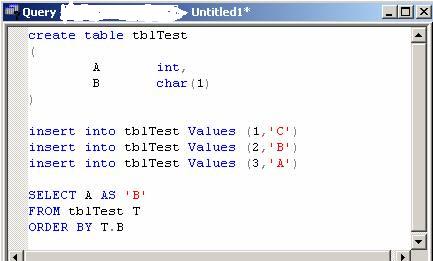
What would the output of the SELECT be?
Now my first reaction was obviously 3, 2, 1 and this would be correct on SQL Server 2005 but unfortunately SQL Server 2000 gives you 1, 2, 3.
Quite frankly I prefer the SQL Server 2005 method anyway ;-)
I lost :-(
Overwrite PDF with Reporting Services through SOAP
I had this really strange issue with one of my reports in development. Obviously developing a report is not something you do in one run. Because of this nice bug in Reporting Services I am only able to check the output by generating the PDF through the Reporting Services webservice.
I was getting this funny behavior of PDF files being correct in size and even page numbers but all the pages were empty. When you eventually scrolled through the PDF it would crash saying that the document is invalid.
Apparently the problem is being caused by overwriting the PDF from the .NET application. Deleting the file before creating it seems to solve this issue.
*EDIT*
Aha, found the nasty bugger :-(
FileStream fs = new FileStream(path, FileMode.OpenOrCreate);
instead of
FileStream fs = new FileStream(path, FileMode.Create);
Developers *sigh* :-D
I was getting this funny behavior of PDF files being correct in size and even page numbers but all the pages were empty. When you eventually scrolled through the PDF it would crash saying that the document is invalid.
Apparently the problem is being caused by overwriting the PDF from the .NET application. Deleting the file before creating it seems to solve this issue.
*EDIT*
Aha, found the nasty bugger :-(
FileStream fs = new FileStream(path, FileMode.OpenOrCreate);
instead of
FileStream fs = new FileStream(path, FileMode.Create);
Developers *sigh* :-D
Monday, December 19, 2005
SQL Server Management Studio - Faster Start
Check out this post for more information about the command line parameters for SSMS.
Adding the nosplash parameter really speeds up starting Management Studio. Just add -nosplash to your SSMS shortcut.
How's that for an easy gain!
Adding the nosplash parameter really speeds up starting Management Studio. Just add -nosplash to your SSMS shortcut.
How's that for an easy gain!
Thursday, December 15, 2005
MSDN Product Feedback Center
As you can see in a post from yesterday there is a nice website that enables you to send suggestions to Microsoft.
Check it out here
Check it out here
Wednesday, December 14, 2005
Those darn statistics
Recently I had this funny query which ignored and index although it seemed very useful to me. Normally I don't question the query optimizer too much but this time I was really sure.
I tried a UPDATE STATISTICS WITH FULLSCAN on the index and all of the sudden my query started to use the index.
Statistics on indexes are always created with fullscan because SQL Server has to scan all of the data anyway. This counts for newly created indexes and reindexing. As far as I can see auto statistics update is always performed by sampling the index or table.
Time for some more testing tomorrow! :-)
I tried a UPDATE STATISTICS WITH FULLSCAN on the index and all of the sudden my query started to use the index.
Statistics on indexes are always created with fullscan because SQL Server has to scan all of the data anyway. This counts for newly created indexes and reindexing. As far as I can see auto statistics update is always performed by sampling the index or table.
Time for some more testing tomorrow! :-)
Product Suggestions
I got around to submit a product suggestion to Microsoft (for SQL Server 2005).
I loved the shortcut to 'Manage Indexes' from the query plan to create some temporary indexes for performance testing. It was a very handy feature that made performance tuning a bit easier. I've submitted a suggestion here (go vote!)
I'm also following 2 other suggestions. One being the complete 'Script As' script with DROP and CREATE statements, check it out here.
Finally there is the very unhandy 'feature' of not being able to load scripts in the current connection and database context, check it out here.
It seems I'm a bit conservative and want isqlw features back :-)
I loved the shortcut to 'Manage Indexes' from the query plan to create some temporary indexes for performance testing. It was a very handy feature that made performance tuning a bit easier. I've submitted a suggestion here (go vote!)
I'm also following 2 other suggestions. One being the complete 'Script As' script with DROP and CREATE statements, check it out here.
Finally there is the very unhandy 'feature' of not being able to load scripts in the current connection and database context, check it out here.
It seems I'm a bit conservative and want isqlw features back :-)
Thursday, December 08, 2005
SQL Server 2005 BOL Update
Wow, Microsoft already released an update of the samples and books online for SQL Server 2005. That's very nice, keep up the good work!
They are already working on the next version btw :)
SQL Server 2005 BOL
SQL Server 2005 Samples
They are already working on the next version btw :)
SQL Server 2005 BOL
SQL Server 2005 Samples
Sunday, December 04, 2005
An unexpected error occurred in Report Processing. (rsUnexpectedError) - Follow up
In this post I had a little problem with Reporting Services.
I didn't have time to investigate it a little deeper until a couple of weeks ago. The problem is that there is no real solution for the time being. Even SQL Server 2005 Reporting Services experiences the same issue.
So I finally decided to submit it to Microsoft Support. They have confirmed that it is a bug in Reporting Services and the developers are looking into it. Let's see how they fix it ;-) I'll keep you posted of course.
I didn't have time to investigate it a little deeper until a couple of weeks ago. The problem is that there is no real solution for the time being. Even SQL Server 2005 Reporting Services experiences the same issue.
So I finally decided to submit it to Microsoft Support. They have confirmed that it is a bug in Reporting Services and the developers are looking into it. Let's see how they fix it ;-) I'll keep you posted of course.
Wednesday, November 30, 2005
New System Objects in SQL Server 2005
One of the first and hardest things to achieve when a new version comes out it get rid of old habits. I'm sure you all used the sysobjects, syscolumns, ... and many others quite often. With SQL Server 2005 however there are some changes and lots of these tables have replacement views and extra information although the old tables are kept for backward compatibility.
Check the BOL for "Mapping SQL Server 2000 System Tables to SQL Server 2005 System Views"
ms-help://MS.SQLCC.v9/MS.SQLSVR.v9.en/tsqlref9/html/a616fce9-b4c1-49da-87a7-9d6f74911d8f.htm
This contains a nice overview of the old tables and their new replacement view. Also remember the ANSI standard INFORMATION_SCHEMA views which still exist in SQL Server 2005 of course.
Check the BOL for "Mapping SQL Server 2000 System Tables to SQL Server 2005 System Views"
ms-help://MS.SQLCC.v9/MS.SQLSVR.v9.en/tsqlref9/html/a616fce9-b4c1-49da-87a7-9d6f74911d8f.htm
This contains a nice overview of the old tables and their new replacement view. Also remember the ANSI standard INFORMATION_SCHEMA views which still exist in SQL Server 2005 of course.
Monday, November 28, 2005
Clock Hands
A very interesting post from our favorite SQL Memory Management Guru.
Oh yes... my first day @ work :-)
Oh yes... my first day @ work :-)
Monday, November 21, 2005
Layla
It's been a long time but there is a good reason ;)
My wonderful babygirl Layla was born on 14/11/2005
Weighing 3,110 kg and measuring 48,5cm.
Sleepless nights here they come :-s
My wonderful babygirl Layla was born on 14/11/2005
Weighing 3,110 kg and measuring 48,5cm.
Sleepless nights here they come :-s
Thursday, November 10, 2005
Microsoft SQL Server Management Studio
Like all people I tend to stick to what I know (especially when it comes to tools). I started with SQL Server 6.5 and back in those days isqlw (later Query Analyzer) was really your friend because anything else than creating a table was not really a joyful process. Having this background I am big supporter of Query Analyzer which after all those years I still start using Start - Run - isqlw :-D
When Microsoft announced that the Enterprise Manager and Query Analyzer would be integrated in one big Management Studio I wasn't too happy. Obviously feelings are irrelevant in IT and I felt that I had to face reality one day or another; so I decided to install Management Studio and to start using it from now on.
After some time you will notice that you get used to everything. I have to admit that my unhappy feelings are fading away and I'm beginning to see the 'cool' features of Management Studio. One big improvement is to script all your modifications to an object directly to a Query window instead of the clipboard. Some are simple but very useful like the ability to resize/maximize every window. When it comes to big databases the tree is more intelligent so that it only loads the parts you select. Having to load all tables, stored procedures, ... from all databases while you are perhaps only interested in 1 table in 1 database doesn't make any sense right?
One of the things I immediately changed were the keyboard shortcuts. I'm quite addicted to sp_help and sp_helptext and being able to select an object and get all it's information with a simple shortcut has saved me many hours.
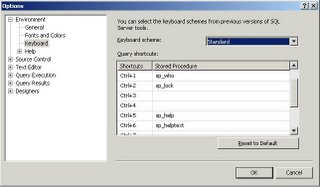
When Microsoft announced that the Enterprise Manager and Query Analyzer would be integrated in one big Management Studio I wasn't too happy. Obviously feelings are irrelevant in IT and I felt that I had to face reality one day or another; so I decided to install Management Studio and to start using it from now on.
After some time you will notice that you get used to everything. I have to admit that my unhappy feelings are fading away and I'm beginning to see the 'cool' features of Management Studio. One big improvement is to script all your modifications to an object directly to a Query window instead of the clipboard. Some are simple but very useful like the ability to resize/maximize every window. When it comes to big databases the tree is more intelligent so that it only loads the parts you select. Having to load all tables, stored procedures, ... from all databases while you are perhaps only interested in 1 table in 1 database doesn't make any sense right?
One of the things I immediately changed were the keyboard shortcuts. I'm quite addicted to sp_help and sp_helptext and being able to select an object and get all it's information with a simple shortcut has saved me many hours.
Wednesday, November 09, 2005
Scalable shared databases are supported by SQL Server 2005
A very interesting KB article about Shared Databases
Tuesday, November 08, 2005
Reporting Services 2005 for clientside reports
Aha, I've been given the assignment to investigate the feasibility of Reporting Services 2005 for our online reports in the client application.
This however requires some specific features:
- multiple language
- take xml as input (using xpath in textboxes)
- import of ActiveReports files
- ...
Does anyone have any experience with this yet?
This however requires some specific features:
- multiple language
- take xml as input (using xpath in textboxes)
- import of ActiveReports files
- ...
Does anyone have any experience with this yet?
Thursday, November 03, 2005
SQL Server 2005 Adoption Rates
Check out this report on migrating to SQL Server 2005 by Edgewood Solutions.
Monday, October 31, 2005
Uninstall SQL Server 2005 CTP
With the release of the RTM version you probably all want to remove the CTP version ;-)
There is a handy tool to help you with this process called sqlbuw.exe which can be found in the CTP install directory under Setup Tools\Build Uninstall Wizard\sqlbuw.exe
There is a handy tool to help you with this process called sqlbuw.exe which can be found in the CTP install directory under Setup Tools\Build Uninstall Wizard\sqlbuw.exe
Friday, October 28, 2005
Visual Studio 2005/SQL Server 2005
Oh yes... blog post 1000 about the release probably :-)
But just to make sure... it has arrived!!!
Congratulations to the team and let it come to me now :-D
But just to make sure... it has arrived!!!
Congratulations to the team and let it come to me now :-D
Thursday, October 27, 2005
MCITP: Database Developer
The Microsoft certifications have been reorganized and apparently there is a difference between a database administrator and a database developer.
A very welcome split.
The customer where I'm currently located uses this philosophy too. We have about 7 Development DBA's (including me) and 4 Operational DBA's.
Although most software developers are capable of writing queries it amazes me how little most of them *really* know about SQL Server. On the other hand a database developer's point of view is also very different from that of a database administrator.
I'd like to hear if there are any people out there opposing this split.
Anyway, check out the new certification here
A very welcome split.
The customer where I'm currently located uses this philosophy too. We have about 7 Development DBA's (including me) and 4 Operational DBA's.
Although most software developers are capable of writing queries it amazes me how little most of them *really* know about SQL Server. On the other hand a database developer's point of view is also very different from that of a database administrator.
I'd like to hear if there are any people out there opposing this split.
Anyway, check out the new certification here
Tuesday, October 25, 2005
Monday, October 24, 2005
Wednesday, October 19, 2005
Reporting Services Linked Report Generator
Wow this is one cool tool!
But remember... a fool with a tool is still a fool :-)
But remember... a fool with a tool is still a fool :-)
Tuesday, October 18, 2005
Does it matter if I build the clustered index before/after rebuilding the non-clustered indexes?
I was reading a QA on one of Kimberley's great sessions when I came across this interesting question and even more interesting answer. I had always been told that a rebuild of your clustered index causes a rebuild of your non clustered indices, apparently it needs to be more refined.
Does it matter if I build the clustered index before/after
rebuilding the non-clustered indexes?
You should always create the clustered index before creating non-clustered
index but as for rebuilding - you can rebuild your indexes independently as a
rebuild of the clustered does not (generally) cause a rebuild of the
non-clustered. There is one exception to this rule in SQL Server 2000 – in 2000
ONLY, SQL Server will automatically rebuild the non-clustered indexes when a
non-unique clustered index is rebuild. Why? Because the uniqueifiers are
rebuilt.
Subscribe to:
Posts (Atom)

